I was reminded of the tremendous elasticity of narrative forms when I recently visited the Denver Art Museum’s amazing American Indian art collection for the first time, by the Haida storytelling pole near the entrance of the collection. The Haida is a native tribe of the Northwest coast of the United States and Canada and, like other tribes of the coast, are known for the immense carved poles through which tribal myths are told.
The story told in this pole is about a man who was almost captured by otters when his canoe capsized. The figures at the very top of the pole are watchmen. Next lowest is the man who escaped the otters, holding an otter by the tail. The figure in the middle represents the cave where the otters live and at the very bottom is a cave spirit, who holds a stingray.
My own inclination was to try to “read” the pole in a linear direction, from top to bottom, to find in it the action part of the story, in which the man escapes the otters. But the real story may lie less in the pole itself than in the interaction between community members and the symbolic item, Continue reading
E.M. Forster famously distinguished events that are yoked only by their temporal order from those that we would consider a narrative (which he called “plot”), in which events are causally linked, with this pithy comparison:
1. The King died and then the Queen died (2 events tied only by temporal order)
2. The King died and then the Queen died of grief (the second event is caused by the first)
I’ve had this distinction on my mind as year-end wrap-ups circulate in the media.
Protestors on Wall Street, September 30, 2011
The global scope of economic crisis and dramatic protests give commentators a lot of latitude to tell the story of this year in a variety of ways. Did Mohamed Bouazizi’s galvanizing protest by fire, and the subsequent fall of the Tunisian government cause Egyptian protests? And did these, in some way cause Occupy Wall Street? Do the protests in Chile, Tel Aviv and Russia have anything to do with each other, or with others? Continue reading
Kare Anderson Coaches Leaders to Get from "Me to We"
Kare Anderson has been a leader in communication in virtually every medium there is for over 30 years. She is an Emmy-winning former Wall Street Journal and NBC reporter, the author of a number of books about conflict resolution and collaboration in business, and publishes the online newsletters Moving from Me to We and Say it Better.
Kare’s most powerful communications though, come through in her coaching. She has led issue teams for the Obama 2008 campaign, advised CEOs, professional athletes, and cause advocates. All seek to have their story heard in highly competitive environments.
When we met recently, I immediately knew I’d like to interview Kare about how she uses narrative in her practice. In our few minutes on the phone last week, she offered concise wisdom and specific strategies for using collaborative techniques to achieve preferred outcomes—no small feat in a complex, noisy world.
AZ: How does storytelling and narrative play a role in your coaching?
KA: For me one of the most difficult things is that people instinctively talk about themselves. When they’re standing on the stage talking to their employees, they talk about their company; they don’t talk about what’s in it for the employees. Many times when people are trying to tell their story they miss the biggest part, which is to construct it so it’s a purposeful narrative-so that the listener can see a role for themselves, want to jump in, retell it and play a role in it. When I think about storytelling, it is to understand what a person most stands for, what they want to get across and how they can authentically discuss it with someone elsewhere that person wants to jump in. The instinct is for people to ask a question and revert it back to themselves. Even when they want something from someone else. Continue reading
At the RAND Corporation in Santa Monica, CA, November 29
From the State Department Announcement:
The U.S. Advisory Commission on Public Diplomacy will hold a public meeting on the topic of strategic narratives November 29, 2011, in Santa Monica, CA, in partnership with the RAND Corporation. The meeting will take place at the RAND offices at 1776 Main Street in Santa Monica, CA, in the Forum Auditorium. It will begin at 9:00 am and end at 3:00 p.m. with doors open for registration and continental breakfast at 8:30 a.m. The event will be webcast live and will emphasize open-forum question and response periods with the audience.
To attend, contact the RAND Corporation no later than November 21 by phone at (412)683-2300 ext 4906 or email to maria_falvo@rand.org and provide your full name, citizenship (U.S. citizenship is not required to attend), and institutional/organizational affiliation. Continue reading
In his new book, Thinking Fast and Slow, Princeton professor and Nobel Laureate Daniel Kahneman describes how, as a psychologist serving in the Israeli army, he selected candidates for officer training based on their success in a series of leadership tests. Despite his own and his colleagues confidence in their choices, “the evidence was overwhelming”: they were no good at predicting success at all. Kahneman explains:
You may be surprised by our failure: it is natural to expect the same leadership ability to manifest itself in various situations. But the exaggerated expectation of consistency is a common error. We are prone to think that the world is more regular and predictable than it really is, because our memory automatically and continuously maintains a story about what is going on, and because the rules of memory tend to make that story as coherent as possible and to suppress alternatives. Fast thinking is not prone to doubt. Continue reading
Earlier this month, Benjamin Hopkins and Magnus Marsden, authors of the forthcoming Fragments of the Afghan Frontier, argued strenuously in a New York Times Op Ed that the U.S. strategy in Afghanistan is as culturally inept as it was when we went to war a decade ago. The American obsession with viewing Afghanistan though the lens of tribal tradition is borrowed from 19th century Brits, whose understanding tribal mores was in large part composed of fanciful inventions of their own. Above all:
Afghanistan is not a country of primitive tribes cut off from the modern world. The singular focus on tribes, the Taliban, and ethnicity as the keys to understanding and resolving the conflict misses the nuances of the region’s past and present. Rather than fanatical tribesmen or poor victims in need of aid, many of these people are active and capable participants in a globalized economy.
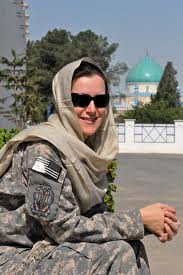
The U.S. military addresses cultural issues, even in how to dress**
Why does this profound institutional failure persist? I read it and hear versions of the premise that Afghans don’t live in the same globalized world as Americans all the time in defense contexts. The fact that it does persist should give us deep pause about how resources have been expended to create a more ‘culturally aware’ national security community. Continue reading
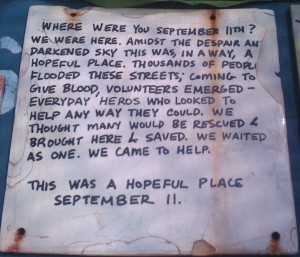
Tile made as part of a project that let people create their own commemorative tiles in 2001; they were later hung on a chain link fence in New York City's Greenwich Village (photo A. Zalman)
Patriotism—love of one’s country—is a treacherous emotion. Too little of it, and we aren’t motivated to make necessary sacrifices on behalf of our national brothers and sisters. Too much of it, or too much of the wrong sort, and exclusionary nationalism—in the form of various ethnic and religious hatreds- takes over. The challenges of getting patriotism right people think that we should avoid these dangers and keep emotion out of our public lives, substituting instead our critical faculties to reason our way to being fair and kind to each other.
But, as philosopher Martha Nussbaum argues, we require this form of love, “distinct from simple approval, or commitment or embrace of principles” in order to act on behalf of people we have never met—those people invoked by the idea of nation. Continue reading
In our social lives, narrative is not only something we tell but also something we perform. Public rituals like parades give us the chance to chronicle our communities in physical space and display the symbols and activities that define us. The words of George Fitch in Colliers Magazine in 1913, testifying to the popular pleasures of parades, are still true today.
The parade is an essential part of the American temperament. We not only inaugurate by parade, but we rejoice, mourn, commemorate, protest, inspire and argue by parades. Whenever two or three Americans are gathered together with a uniform within reach, they parade… The test of true brotherhood in any city is the willingness to parade in a white apron, a rooster feather hat, or a pair of baggy pink silk trousers.
Among the most joyous of these tests today is surely the annual West Indian American Day parade in Crown Heights, Brooklyn, an astonishing celebration of the colors, music and flavors of Carnival in the Caribbean, held this year on September 5, and an exuberant testament to multiculturalism. Continue reading
Union City, New Jersey, following Hurricane Irene's passage. Photographed by Luigi Novi under Creative Commons License
Turbocharged Reporting Underwhelmed Us
As we now know, the adrenalized coverage of Tropical Storm/Hurricane Irene as it traversed the U.S. East Coast overstated the risk of worst-case scenarios in a number of areas, like lower Manhattan and made them seem as if they were certain outcomes. In fact, hurricane modeling is not a perfectly predictive science. NOAA, the National Oceanic and Atmospheric Agency, is explicit about how its annual hurricane outlooks are probabilistic, which means that potential events simply have some likelihood of occurring (and, in fact, there were areas such as Vermont where the potential for damage was under-forecasted)
I know I wasn’t alone in sensing that much of the media coverage was over the top. My relatives and friends, especially those of us in areas where the worst-case scenarios being put forth didn’t live up to the reality ended up feeling dismissive and irritated and, if we were frightened, slightly humiliated that we had been so easily spooked. I’m sure we’ll all wonder next time whether we should follow authorities’ most stringent instructions about emergency preparation.
When events don’t arrive in the dramatically bad proportions we’ve been expecting, we as likely to tune out authorities or forget entirely that the drama at hand was destructive weather, like the Washington DC woman who reported feeling that the milder than expected storm “”was a bit of a let down.”
The Challenge Communicating Uncertainty
On the other hand, there were also areas in which the degree of potential damage was under-forecast, as in Vermont. Continue reading
The competing narrative continuing to unfold about the ongoing violence in Syria reflect how completely amateur video has now transformed our understanding of what “news” is. Activists’ homemade videos have shattered the idea that the Syrian government’s claim to be restoring “stability” to towns under attack from “armed terrorists” can be taken at face value.
Yet, amateur videos cannot be verified easily, and for that reason also cannot be taken at face value. In order to try to tell the “whole” story, Reuters, CNN and other mainstream sources seem to be frequently reduced to a version of stuttering about how, although they are showing citizen footage, they can’t vouch for it’s accuracy. The New Yorker, commenting on an August 5th video below, notes that, “Like all of the amateur videos coming out of Syria, where the foreign press has been banned, this footage has not been independently verified.”
Other journalists, like Dissected News founder James Miller, are rewriting the terms of journalistic objectivity to try to make sense of, and verify, amateur video claims. Like traditional journalism, this new form requires a zealous desire get the story right and the passion-and knowledge of context-to uncover truth. But it also requires the talents of a film critic—the ability to read images, to interrogate pictures for what they reveal and conceal, and to explore how they are constructed.
As it turns out, a picture is not worth a thousand words at all. A picture is just like words – it may tell the truth, it may deceive, but it is never the transparent conduit to fact we once thought it was. It is up to good journalists to decipher them, and learn to read them as they do sources’ statements: as complex, layered signals that say as much about the worldview of the people making them, as they do about events at hand.
… Some news agencies have occasionally been duped by propaganda promoted by individual “activists”, but those observers who are more tuned in, after months of experience, to the claims of the activists, now know which individuals or groups produce credible information, and they know when to be extra-skeptical about reports. However, many of these claims are reliable, and the media who drop in on the Syria story need to pay attention to the journalists who are working hard to separate the “good” reports from the “bad”. Because in Syria — to take a position — one side is lying, one side is mostly truthful, and thousands of lives are in the balance of the two.
Be More Powerful. Create Enduring Impact in a Turbulent World.
We rely on established narratives--or stories about ourselves-- to create order from chaos.
But when the world is in flux, the old narratives don’t explain reality, or help us design the future.
In a turbulent world, we need strategic narratives--stories that we build with intention and strong vision--to guide our next steps, influence our audiences, and achieve our visions.
Founded by Amy Zalman, Ph.D., Strategic Narrative helps leaders, strategists and vanguard thinkers everywhere who recognize our world is changing, to assess these changes and chart their own course on our globally unmapped future.