tag archive: psychology

Narrative Believability Trumps Probability in Decision Making

We may be better at telling the story behind a bet than the probable roll of the dice

We are not statisticians by nature, but storytellers. Why don’t we make better use of that insight in our effort to predict and understand complex problems?

British economist John Kay presented the following problem in a recent Financial Times column When Storytelling Leads to Unhappy Endings:

Linda is single, outspoken and deeply engaged with social issues. Which of the following is more likely? That Linda is a bank manager or that Linda is a bank manager who is an active feminist?

If you chose the second answer you are in good company. Most of us do. Sadly, we’re wrong. Kay explains:

Many people say that the second option is more likely. Yet, the standard response goes, this cannot be. The rules of probability tell us the probability that both A and B are true cannot exceed the probability that either A or B is true. It is less likely that someone is a female Jamaican Olympic gold medalist than that a person is female, or that a person is Jamaican, or that a person is a gold medalist. Yet even people trained in probability make a mistake with the Linda problem. Or is it a mistake? Little introspection is required to understand what is going on. Respondents do not interpret the question as one about probability. They think it is a question about believability.

Believability, as Kay explains further, is narrative’s emblem. In the face of the messy, multi-faceted and open-ended situations that confront us, we humans tend to produce “simplifying narratives” that help make sense of events in a way we find believable, based on our personal, cultural and historical predispositions. Continue reading

Posted in: Crisis Management, Decision making, Narrative and Cognition, Narrative Research Tags: , , , , , , , , ,

Behavioral Economics Go to War

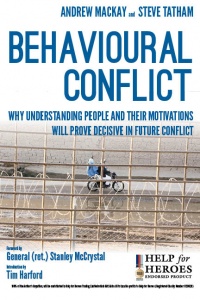
Review of Behavioural Conflict, Why Understanding People and their Motivations Will Prove Decisive in Future Conflict, by Andrew Mackey and Steve Tatham

I cannot think of any books about warfare’s future that come across as hard-hitting, full of actionable pragmatism, and deeply humane all at the same time. But Behavioral Conflict: Why Understanding People and their Motivations will Prove Decisive in Future Conflict is all three. The authors, both career members of the British military, Major General Andres Mackey (Ret) and Royal Navy Commander Steve Tatham (who I count as a friend, having met him in Ankara a few years ago), make their case by drawing on a combination of their own experience, case studies and close analysis of how communication actually factors in war.

Hard-hitting and pragmatic: Mackey and Tatham are precise and lucid about what they mean by “behavior” and how to make use of it to gain advantage in conflict. They, and behavioral psychologist Lee Rowland, who adds a chapter on the science of influence, are not putting forth any of the following: A call for greater “cultural awareness,” a mushy program about how to change others’ attitudes, or a repeat of the last decade’s focus on consumer marketing as the key to public diplomacy. They offer instead this thesis based on a simple chain of claims:

  • The world of human motivation and perception is inevitably complex.
  • It is more important to try to shape behavior than it is to change people’s attitudes.
  • Behavior shaping begins with a discrete grasp of the circumstances under which people already behave in ways that are desirable, and extends to efforts to replicate those or similar circumstances. Continue reading

Posted in: Books & Films, Decision making, Intercultural Communication, International Politics, Narrative Research, National Security, Politics and Policy, Strategic Leadership, War and Violent Conflict Tags: , , , , , , , , , , , , , , ,

Overconfident Narratives Skew Decision Making

In his new book, Thinking Fast and Slow, Princeton professor and Nobel Laureate Daniel Kahneman describes how, as a psychologist serving in the Israeli army, he selected candidates for officer training based on their success in a series of leadership tests. Despite his own and his colleagues confidence in their choices, “the evidence was overwhelming”: they were no good at predicting success at all. Kahneman explains:

You may be surprised by our failure: it is natural to expect the same leadership ability to manifest itself in various situations. But the exaggerated expectation of consistency is a common error. We are prone to think that the world is more regular and predictable than it really is, because our memory automatically and continuously maintains a story about what is going on, and because the rules of memory tend to make that story as coherent as possible and to suppress alternatives. Fast thinking is not prone to doubt. Continue reading

Posted in: Crisis Management, Decision making, Narrative and Cognition, Narrative Research, Strategic Leadership, Uncategorized Tags: , , , , , ,

Hurricane Irene News Coverage Pummels Viewers with Worst-Case Scenarios

http://commons.wikimedia.org/wiki/File:8.28.11IreneSunsetByLuigiNovi13.jpg

Union City, New Jersey, following Hurricane Irene's passage. Photographed by Luigi Novi under Creative Commons License

Turbocharged Reporting Underwhelmed Us

As we now know, the adrenalized coverage of Tropical Storm/Hurricane Irene as it traversed the U.S. East Coast overstated the risk of worst-case scenarios in a number of areas, like lower Manhattan and made them seem as if they were certain outcomes. In fact, hurricane modeling is not a perfectly predictive science. NOAA, the National Oceanic and Atmospheric Agency, is explicit about how its annual hurricane outlooks are probabilistic, which means that potential events simply have some likelihood of occurring (and, in fact, there were areas such as Vermont where the potential for damage was under-forecasted)

I know I wasn’t alone in sensing that much of the media coverage was over the top. My relatives and friends, especially those of us in areas where the worst-case scenarios being put forth didn’t live up to the reality ended up feeling dismissive and irritated and, if we were frightened, slightly humiliated that we had been so easily spooked. I’m sure we’ll all wonder next time whether we should follow authorities’ most stringent instructions about emergency preparation.

When events don’t arrive in the dramatically bad proportions we’ve been expecting, we as likely to tune out authorities or forget entirely that the drama at hand was destructive weather, like the Washington DC woman who reported feeling that the milder than expected storm “”was a bit of a let down.”

The Challenge Communicating Uncertainty

On the other hand, there were also areas in which the degree of potential damage was under-forecast, as in Vermont. Continue reading

Posted in: Crisis Management, Decision making, News and Journalism, Public Relations Tags: , , , , ,

5 Points about Using Numbers in Narrative

random-colored-numbers-480x309

1. Numbers and Narratives: Frenemies

We want to sort story from statistic. Story can seem to be spin, while numbers appear to speak for themselves and reflect an unimpeachable reality. Our insistence that what is “social be “science” makes us think that numbers can stand in for reasoning and context to explain the world around us. Yet, we also don’t understand statistics very well, which makes most of us easy victims of numbers that only seem to mean something, when they’re cushily framed by persuasive stories. But it wasn’t always so, recounts Roberto Franzosi in From Words to Numbers. Consider:

…the etymological roots of the words “count” (numbers) and “recount,” as in narrative or tell a story (words). The word “recount” was imported into English from the French reconter in the fifteenth centry. In French, the verb reconter, a close proxy of conter, hasd been adopted in the twelfth century from the Latin computare (meaning reckon and calculate). And computare (meaning reckon and calculate). And numbers, telling and measuring, counting and recounting, were once simply intellectual activities, involved thinking, or, more appropriately, enumerating or going through a sequential list.

Here then, a short list of ways to bridge the historical divide, and reunite narrative and number.

2. Frameworks Institute: “Don’t fight the narrative with numbers”

According to Frameworks, which helps institutions shape discourse around social issues, numbers and facts are not persuasive to people, if the cited numbers counter strongly held worldviews.

The fact is that many Americans find it hard to digest data and interpret it; mathematical literacy is a major hurdle. But, that aside, the psyche is often resistant to data that erode a comfortable view of the world. Quite often, the numbers are reinterpreted to substantiate an entirely different conclusion. From the social science roots of framing research we learn this maxim: If the facts don’t fit the frame, the facts get rejected not the frame.

New numbers won’t fix an outworn frame, is the message. Continue reading

Posted in: Books & Films, Narrative and Cognition, Narrative Research, Politics and Policy Tags: , , ,

The Psychology of Conspiracy Theorists

Conspiracy Theories are Narratives on Steroids

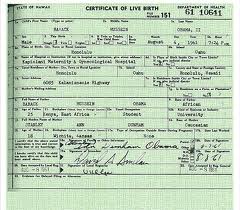
President Obama's Birth Certificate Doesn't Quell Conspiracy Theory that He Isn't an American Citizen

Conspiracy theories are narratives on steroids. In a story, the plot moves forward when one thing causes the next. In a conspiracy theory, cause is an outsized malignant force that knows everything and controls all events. Nothing happens randomly, all events are tied to the larger purpose of an always mysterious, always malefic agent. The amplification of current events into objects of global scrutiny also amplifies conspiracy theories, making them powerful agents in shifting public opinion. Thus with the so-called Birthers framing of President Obama as a foreigner, despite the overt presentation of facts proving that the president was born in the American state, Hawaii.

Conspiracy theorists stubbornly resist the facts at hand, finding reasons other than those given for why events unfold the way they do. Many Pakistanis appear to doubt that Osama bin Laden died as reported in mainstream news. According to a Gallup poll, “nearly half (49%) thought that the whole incident was actually staged for some reason or other. Only 26% thought the al-Qaeda chief was really killed on the night in question.” That’s a lot of people who think that the story circulated in mainstream media is crackpot, at best. And this week, 57% of respondents to a French poll believe that Dominique Strauss-Kahn is the victim of a conspiratorial plot by political rivals, rather than the victimizer of a hotel housemaid, as has been reported. Continue reading

Posted in: Books & Films, Conspiracy Theories, International Politics, Narrative Research, Politics and Policy, Popular Culture Tags: , , , , , , , ,