tag archive: personal stories

7 Necessary Narratives for the New Digital Age

In the future, nearly everyone will be connected to the Internet and to each other, claim Jared Cohen and Eric Schmidt in The New Digital Age.

Mass connectivity will transform our relationships, our governments, our work, our bodies and the objects around us. But even these dramatic transformations will not change the fact that we are corporeal creatures, and that we will still live lives grounded in phnew digital agephysical circumstances, whether those are urban or rural, rich or poor, lucky or unlucky.

We will also come into the world with a set of inherited stories about who we are, what our lives mean, and what the future looks like. These stories will have the same universal threads they always have: we will still have stories of love, stories of family, stories that try reconcile life’s fundamental unfairness. But they will also fail in important ways to explain the transformations of our lives, and the new ways in which we will do old things.

We need new stories

We need new stories. Creating them is of necessity not only a collective task, but a transnational one. As we grow even more connected, we also grow more capable of exporting our ideas about who we are and what is important on others, wherever they are. Yesterday, two Nigeria-descended men hacked a third to death on a London street, and then stayed on the scene to tell how they saw themselves in a world at war: “We must fight them as they fight us.” As we grow more connected, and more willing to share our selves with others, maybe pernicious forms of shame—that universal emotion—will be knocked out, and we’ll be more healthy.

It all depends on how we decide to tell our future. Here are seven of the areas where we will need new stories in the new digital age, as described by Schmidt and Cohen.


7 Necessary Narratives for the New Digital Age

1. The Body

Both religion and science fiction have long dreamed of worlds in which humans transcend bodies, to become virtual souls. In the new digital world, however, we will shape our identities online but experience them in the physical world. How will we understand health and illness, and mortality, if we have the capacity to monitor our daily rhythms in minute ways?

2. Personal Identity

Schmidt and Cohen tell us that identity will be each of our most valuable commodity in the future, and that our true personal identity will be the one that we shape online.

How will we choose to tell our life stories and in what ways will the autobiographical form change in a world in which there is essentially no privacy? Where will we think our “real” self resides. Where will the associations with privacy as a space of intimacy, daydreaming, erasable exploration, unrecorded experimentation with who we are, in order to practice who we could be, relocate, when we have no privacy?

3. News

Our concepts of journalism and news reporting have already undergone dramatic changes; journalism has become in many ways a collective task that falls to professional reporters and citizens alike, and to groups and organizations that put out versions of the news that support particular causes or points of view.

As an increasing number of voices join in the journalistic task, the work of professional media will evolve. The media might become a trusted validator of unsubstantiated accounts, or an integrator of news from different kinds of sources. The value of objectivity may fade, while versions of what subjective news that maintains its integrity will emerge—this will be the new narrative of news.

4. Cybersecurity

Different forms of public security – whether they are in the arena of health, or counterterrorism, or child safety – operate according to different metaphors, storylines and images. Those around cyber-security may coalesce around metaphors of health and hygiene: we are told to practice “cyber-hygiene.

Schmidt and Cohen introduce Microsoft Chief Research and Strategy Officer, who has also recommended a “World Health Organization” for cyber-activity, and the practice of quarantining computers that have been infected with viruses. As Adriane Lapointe, a National Security Agency official has observed, the public health metaphor may serve as the basis for a meaningful public narrative:

Like any good metaphor, it invites us to consider illuminating similarities between two overtly dissimilar things—malware on the internet and infectious disease in a community—similarities that can lead us to reframe a familiar topic. It also identifies a policy precedent, reminding us that we do, as a society, recognize the need to impose some restrictions on individuals who involuntarily pose a certain kind of threat to others, and that we have a mechanism to do this which might be relevant to cybersecurity matters. Whether we ultimately decide that this mechanism or approach is appropriate to the cyber challenge, the metaphor has certainly helped to broaden thinking about the subject.

5. National Identity

The nation-state has been the bedrock of our civic identities for the last couple of centuries, and the idea that every nation deserves its own territorial state a driving narrative of the 20th century. But new diasporas resulting from increased migration, coupled with digital connectivity, are decoupling the nation from the state, creating virtual, de-territorialized nations.

How will a de-territorialized nation narrate its future? How will cultural practices that have been grounded in place be translated into practices of other place? Will other forms of bonding, such as investment in the home country, become a standard part of an individual’s narrative of their national identity? Will the idea of a relationship to a particular land wither for some communities, and if so, to what effect?

6. Dissident Leadership

There is much to protest in this world, and the low cost of entry to share dissident views will lead to a widening number of protestors seeking attention for their cause. Many of these causes will be worthy and compelling, so it is no longer enough to offer the platitude the most persuasive stories will gain our attention. Rather, we—the public that dissidents must win over-may begin to change the meta-story, or standards, by which we evaluate leaders and causes.

Schmidt and Cohen offer that dissident leaders likely to become popular will be able to: “command a following and crowd-source their online support,” will know how to exploit digital marketing tools, and will show their commitment by putting themselves at physical risk.

We can already guess that digital marketing skills are not the most important skills for someone seeking a leadership role in a dissident setting. We can use this recognition starting now to inoculate ourselves against easily accepting simply the most digitally skilled. We can ask, instead, what are the qualities—what is the story—of a leader who is likely to be successful, who understands the institutions they want to change, and lead that change on the ground as well as in virtual space.

7. Justice

Cameras in our smallest devices make it easy to record the human capacity for barbarism in its many forms. Violence, sexual assault, cruelty to animals, hate speech all find their way into digital form on a regular basis, easily arousing our instinctual repugnance. As Schmidt and Cohen observe, these recordings can become the basis for “crowd sourced justice,” which may take the form of mob retaliation, from harassment to violence.

But we could instead form new habits of collective responsibility—using our connectivity to make sure that those who commit bad acts are dealt with according to our legal precepts and best values, and to explore together how to deal with bad behavior at the community level. Which narrative, and which set of practices that prevail, depend on how we decide to narrate our opportunity to ‘crowd source justice,’ which behaviors we highlight and celebrate, and how we talk about what we see online.


Posted in: Books & Films, Intercultural Communication, International Politics, Marketing & Branding, Popular Culture, Public Relations Tags: , , , , , , ,

Narrative for Survival: My Grandmother’s Story

Stories can save lives. In One Thousand and One Nights, Sheherezade uses her storytelling talents to end King Shahrayr’s plot to punish his unfaithful wife by punishing all of the women of his kingdom. Having put to death the unfaithful Queen herself, the King embarks on a plan to marry a virgin of the Kingdom each night, and to have each killed at dawn. That is, until he marries Sheherezade, who spends her wedding night narrating to the King a most exciting and suspenseful tale. So exciting that the King puts off her death to hear how the story continues. And so their story continues for a thousand and one nights, after which the King abandons his goal to punish women, and marries Sheherezade.

My grandmother may not have had a thousand stories, but she had at least one, and telling it to an American Consul in 1939 saved her life and that of her husband and baby, when it permitted her to leave warring Europe on one of the last ships to cross the Atlantic. I had the opportunity to tell it at a local TedX event earlier this year, and was delighted when TEDx organizers chose it as one of their favorites. I’d love to hear about other stories that have saved lives, if you have one you’d like to share.

Posted in: Books & Films, Intercultural Communication, International Politics, Narrative forms, Politics and Policy, Popular Culture, War and Violent Conflict Tags: , , , , , , , , , ,

“Stand your Ground” Laws Validate Stories of Lethal Force, Silence Others

Yale Law School professor Adam Cohen, advocating the repeal of the Stand Your Ground law that permitted George Zimmerman to claim he killed Trayvon Martin in self defense, wrote in Time Magazine last week that:

If Zimmerman does go to trial, there will no doubt be enormous debates over his guilt or innocence. It is difficult to sort out motives and right and wrong in cases of this sort — especially when one of the critical witnesses, young Mr. Martin, cannot testify about what happened.

There is a direct link between Stand Your Ground laws, which permit those with access to deadly force to use it if they feel threatened, and Martin’s inability to tell his story.

Spirit of JusticeSpirit of Justice, cropped from photograph: Two sculptures "Spirit of Justice," and "Majesty of Justice," Great Hall, 2nd floor, Department of Justice, Washington, D.C.

It is a truism when talking about narrative and public life to assert that some stories are sanctioned, and others silenced. Sometimes it is difficult to identify the mechanism through which such sanction takes place, because it lies in community tradition or social discourse. Stand Your Ground laws press into relief how law can shape which accounts will be viewed as legitimate before they are evaluated by judges and juries. Under the Stand your Ground premise, might makes right. Your ability to lethally harm someone is converted into the credible motivation for doing so, while the victim of a killing is doubly silenced, in court and in life.

When I consider the reported details of the case in the press-the accounts of Zimmerman and his father, the 911 call transcripts, the reports of the neighbors and Martin’s girlfriend, who overheard the encounter by cell phone, I hear a story of two young men who each experienced sensations of threat and fear in the presence of the other. Continue reading

Posted in: Legal Issues, Narrative forms, Narrative Research, News and Journalism, Politics and Policy Tags: , , , , , , ,

High Powered Collaboration, a New Narrative for Leaders: an Interview with Kare Anderson

Kare Anderson Coaches Leaders to Get from "Me to We"

Kare Anderson has been a leader in communication in virtually every medium there is for over 30 years. She is an Emmy-winning former Wall Street Journal and NBC reporter, the author of a number of books about conflict resolution and collaboration in business, and publishes the online newsletters Moving from Me to We and Say it Better.

Kare’s most powerful communications though, come through in her coaching. She has led issue teams for the Obama 2008 campaign, advised CEOs, professional athletes, and cause advocates. All seek to have their story heard in highly competitive environments.

When we met recently, I immediately knew I’d like to interview Kare about how she uses narrative in her practice. In our few minutes on the phone last week, she offered concise wisdom and specific strategies for using collaborative techniques to achieve preferred outcomes—no small feat in a complex, noisy world.

AZ: How does storytelling and narrative play a role in your coaching?


KA
: For me one of the most difficult things is that people instinctively talk about themselves. When they’re standing on the stage talking to their employees, they talk about their company; they don’t talk about what’s in it for the employees. Many times when people are trying to tell their story they miss the biggest part, which is to construct it so it’s a purposeful narrative-so that the listener can see a role for themselves, want to jump in, retell it and play a role in it. When I think about storytelling, it is to understand what a person most stands for, what they want to get across and how they can authentically discuss it with someone elsewhere that person wants to jump in. The instinct is for people to ask a question and revert it back to themselves. Even when they want something from someone else. Continue reading

Posted in: Crisis Management, Decision making, Intercultural Communication, Narrative and Cognition, Public Relations, Strategic Leadership Tags: , , , , , ,

Lessons in Patriotism

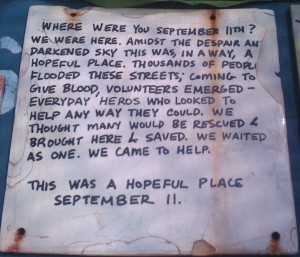
Tile made as part of a project that let people create their own commemorative tiles in 2001; they were later hung on a chain link fence in New York City's Greenwich Village (photo A. Zalman)

Patriotism—love of one’s country—is a treacherous emotion. Too little of it, and we aren’t motivated to make necessary sacrifices on behalf of our national brothers and sisters. Too much of it, or too much of the wrong sort, and exclusionary nationalism—in the form of various ethnic and religious hatreds- takes over. The challenges of getting patriotism right people think that we should avoid these dangers and keep emotion out of our public lives, substituting instead our critical faculties to reason our way to being fair and kind to each other.

But, as philosopher Martha Nussbaum argues, we require this form of love, “distinct from simple approval, or commitment or embrace of principles” in order to act on behalf of people we have never met—those people invoked by the idea of nation. Continue reading

Posted in: Intercultural Communication, National Security, Politics and Policy, War and Violent Conflict Tags: , , , , , , , , , ,

“Adjustment Bureau” Adjusts Individual Lives to Fit Institutional Narratives

The Adjustment BureauThe Adjustment Bureau is a film about narratives, and about who has the power to tell them. Based loosely on the 1954 Philip K. Dick short story, “Adjustment Team,” it tells of the story of the effort by one man (played by Matt Damon) to wrest control over his own life from larger forces. Meanwhile, those forces, in the institution of the “Adjustment Bureau,” maintain that control of human destiny lies in their hands.

“You only have the appearance of free will,” Damon is instructed by one of the elders in the Bureau, an organization that appears to be a cross between a Ford factory and Heaven. The Adjustment Bureau wants Damon, a New York senator, to be president and change the course of world events. They fear that if Damon follows his own heart, and his love for a ballerina, he will lose his ambition.

The film offers much food for thought at a moment when personal struggles to maintain personal control over individual destinies, despite the larger forces of nature and politics, are playing out dramatically on virtually every continent. In Japan, in Libya, in the American Midwest, in Australia, where floods devastated the Queensland coast this winter.

One can’t help but wonder whether the redemptive possibilities that Dick’s vision offers is a fantasy or a model we can take to heart. It also asks us to consider how much agency the institutions that drive our lives possess: our governments, banks, universities, and companies. In The Adjustment Bureau, the institution is deeply interested in the course of individuals’ actions, but only to the extent that they align with the larger intentions of the organization.

Either way, the dramatic conflict between the determinism of the faceless institutions in which we live and the protagonists, who battle that determinism, rings true. And recognizing the inherent tension between individuals and institutions, instead of pasting them over, is a useful step in teasing out the real story of how we realize our ambitions.

Posted in: Books & Films, Popular Culture Tags: , ,

Storytelling as a Key to Systems Development

People and computers have had a close relationship since the first electronic computer was unveiled in 1946 (U.S. Army Photo)

The stakeholders in IT projects often speak in such different terminologies that communication can seem like lucky happenstance. Engineers speak engineer, users speak user, and business people speak their own language too.

Continue reading

Posted in: Information Systems Tags: , , , , ,

The Challenge of Hearing the Opposition

Last week, I had the privilege of guest lecturing about the uses of narrative for defense professionals at the National Defense University. It was a terrific experience all around—the students were impressively willing to think and talk about storytelling, which isn’t exactly a traditional part of a military education.

I was eager to have the students work with material that reflects their real world, and thought a 2009 interview with an Afghan member of parliament telling the story of civilians killed by American bombing in her province would be of great interest. And so it was.

In my own eagerness to bring the content of the video into the classroom, I hadn’t made much of the fact that the interview had been conducted and released by CODEPINK, a women’s anti-war group. Not so the class. After the class, a couple of participants made it clear they disapproved of my video choice.

Continue reading

Posted in: National Security Tags: , , , ,

The danger of a single story

Nigerian novelist Chimamanda Adichie talks about “the danger of a single story:” what happens when a single narrative about a people or place dominates our imagination. For Adichie, it meant she was greeted on arrival in the United States for college with disbelief that the middle class professor’s daughter was authentically African—she was not tribal enough, and was neither starving nor HIV-ridden.

“The single story creates stereotypes and the problem with stereotypes is not that they are untrue, but that they are incomplete. They make one story become the only story.”

Thanks to Michael Paone of the New York City Coalition against Hunger for passing it on.

Posted in: Books & Films, Intercultural Communication, International Politics, Uncategorized Tags: , , ,