
tag archive: patriotism

Let’s Celebrate the 2nd Anniversary of “A National Strategic Narrative”

This has been a tough spring for national cohesion in the United States. Automatic federal spending cuts called sequestration kicked in after Congress failed to agree on how to manage the federal budget. The Senate voted down a bill that would expand background checks for gun purchasers, despite strong support around the country. And bombings at the Boston Marathon committed by young men hovering between foreign identity and American citizenship confused any clear idea of American identity.

This makes it a good time to mark the two year anniversary of A National Strategic Narrative, published in April 2011 by aNational Strategic Narrativeuthors Captain Wayne Porter, USN and Col Mark Mykleby, USMC under the pseudonym Mr. Y.

The document grabbed the attention of politicians and pundits here in the United States, and foreign ministers in Europe and the Middle East. Perhaps most important, it garnered attention from everyday citizens for proposing a reinvigorated American identity and role in the world. Continue reading

Posted in: Books & Films, Decision making, Intercultural Communication, International Politics, National Security, Politics and Policy, Strategic Communication, Strategic Leadership Tags: , , , , , , , , , , ,

Narrative for Survival: My Grandmother’s Story

Stories can save lives. In One Thousand and One Nights, Sheherezade uses her storytelling talents to end King Shahrayr’s plot to punish his unfaithful wife by punishing all of the women of his kingdom. Having put to death the unfaithful Queen herself, the King embarks on a plan to marry a virgin of the Kingdom each night, and to have each killed at dawn. That is, until he marries Sheherezade, who spends her wedding night narrating to the King a most exciting and suspenseful tale. So exciting that the King puts off her death to hear how the story continues. And so their story continues for a thousand and one nights, after which the King abandons his goal to punish women, and marries Sheherezade.

My grandmother may not have had a thousand stories, but she had at least one, and telling it to an American Consul in 1939 saved her life and that of her husband and baby, when it permitted her to leave warring Europe on one of the last ships to cross the Atlantic. I had the opportunity to tell it at a local TedX event earlier this year, and was delighted when TEDx organizers chose it as one of their favorites. I’d love to hear about other stories that have saved lives, if you have one you’d like to share.

Posted in: Books & Films, Intercultural Communication, International Politics, Narrative forms, Politics and Policy, Popular Culture, War and Violent Conflict Tags: , , , , , , , , , ,

A Presidential Campaign, but No Presidential or National Narrative

A presidential campaign is an exercise in storytelling. Each candidate is always seeking to tell the most compelling story of the nation, one that both reflects who we think we are and projects into the future the kind of nation we’d like to be. The very occasion of campaign, with its promise of renewal, should be a strong backdrop for the symbols, themes, images and practices that tie past and future of a nation together.

This year, both Romney and Obama have struggled to find their foothold in a narrative that works. As the near tie in popularity makes clear, neither has a mandate, and neither has told a story with a powerful sense of forward momentum. Continue reading

Posted in: Narrative forms, Political Analysis, Politics and Policy, Strategic Leadership Tags: , , , , , , ,

Lessons in Patriotism

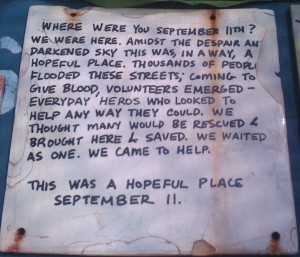
Tile made as part of a project that let people create their own commemorative tiles in 2001; they were later hung on a chain link fence in New York City's Greenwich Village (photo A. Zalman)

Patriotism—love of one’s country—is a treacherous emotion. Too little of it, and we aren’t motivated to make necessary sacrifices on behalf of our national brothers and sisters. Too much of it, or too much of the wrong sort, and exclusionary nationalism—in the form of various ethnic and religious hatreds- takes over. The challenges of getting patriotism right people think that we should avoid these dangers and keep emotion out of our public lives, substituting instead our critical faculties to reason our way to being fair and kind to each other.

But, as philosopher Martha Nussbaum argues, we require this form of love, “distinct from simple approval, or commitment or embrace of principles” in order to act on behalf of people we have never met—those people invoked by the idea of nation. Continue reading

Posted in: Intercultural Communication, National Security, Politics and Policy, War and Violent Conflict Tags: , , , , , , , , , ,