
tag archive: national security

Lessons in Patriotism

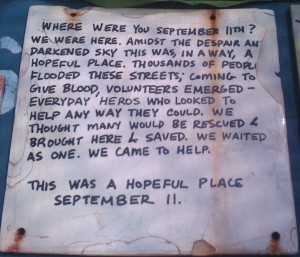
Tile made as part of a project that let people create their own commemorative tiles in 2001; they were later hung on a chain link fence in New York City's Greenwich Village (photo A. Zalman)

Patriotism—love of one’s country—is a treacherous emotion. Too little of it, and we aren’t motivated to make necessary sacrifices on behalf of our national brothers and sisters. Too much of it, or too much of the wrong sort, and exclusionary nationalism—in the form of various ethnic and religious hatreds- takes over. The challenges of getting patriotism right people think that we should avoid these dangers and keep emotion out of our public lives, substituting instead our critical faculties to reason our way to being fair and kind to each other.

But, as philosopher Martha Nussbaum argues, we require this form of love, “distinct from simple approval, or commitment or embrace of principles” in order to act on behalf of people we have never met—those people invoked by the idea of nation. Continue reading

Posted in: Intercultural Communication, National Security, Politics and Policy, War and Violent Conflict Tags: , , , , , , , , , ,

U.S. Should Stop Asking if “They Like Us”

The September 11 attacks spawned a public mania in the United States for uncovering whether people in other parts of the world “like us,” and if not, understand why they “hate us.” Ten years later, the U.S. State Department and, more broadly, national security community is still using this uninformative metric.

It is time to break down what the question “do you like the United States” actually means to those who we ask —whether directly through polling, or through the interpretation of symbolic actions (signs, flag burning) or the aggregation of media statements, or in any other fashion.

Most people in the world, especially those of greatest strategic interest to the U.S., cannot answer whether they like the United States based on personal information or knowledge. Despite rising international travel to the United States, most of the 60 million foreign visitors last year came from just five countries: Canada, Mexico, the UK, Japan and Germany.

The number of those who can answer based on a sense of intellectual or cultural proximity is equally small. The common wisdom since World War II is that American popular culture—movies, television shows, McDonald’s—is loved abroad, even when American policies are not. Globalization encourages competition and hybridization of cultural forms. Economics professor Tyler Cowan has argued that the “21st century will bring a broad mélange of influences, with no clear world cultural leader.” Continue reading

Posted in: Intercultural Communication, International Politics, Middle East, National Security, Politics and Policy, Public Diplomacy Tags: , , , , ,

“Global Drops out of “War on Terror” in post-bin Laden Narrative

When President Obama addressed the nation and the world last night to report Osama bin Laden’ death, I was surprised by the absence of a global element in his message. Obama is known for his multilateral, global approach to foreign affairs, and it the lens through which he seems most comfortable framing American actions in the world. The war waged by the Bush Administration in the aftermath of the 9/11 attacks was relentlessly globalized, as the name “global war on terror” suggested. And it has been a consistent thread in U.S. messaging to remind those in the Middle East and Central Asia, and elsewhere, that bin Laden’s brand of global jihad killed more Muslims than any other group.

Obama’s message last night made a strange reversal. The larger narrative framing the search for and killing of bin Laden was emphatically Americanized.

The effect of this framing, if there is any, remains to be seen. In the global swirl of fast moving media, not to mention events, the President’s words may soon fall away as memorable in the global context. Or they may be picked up—Afghans, Iraqis and Pakistanis as may wonder how much of the brunt of an effort reconceptualized as primarily American they must be called to bear.

We can be sure however, that the reminder that Obama was at the helm during this moment of American bravery is intended as a formative statements in the story of his presidency, which is now being written in advance of the 2012 presidential elections.

Posted in: Middle East, National Security, Political Analysis, War and Violent Conflict Tags: , , , , ,

Body Scanners Expand the State’s Boundaries

bodd scanner

The recent flap over the TSA security measures –both manual pat-downs and backscatter x-ray and millimeter wave scanners—has been painted as presenting a conflict between personal privacy and national security.

We might more accurately call it a conflict over boundaries, personal and national. Who has the right to cross what borders? What is the proper boundary between my body and the state?

This trope, which is also present in other conflicts, like that over abortion, is particularly apt in a battle against terrorism. Boundaries, after all, are precisely what terrorists violate. Violent actors’ capacity to terrorize originates in their readiness to transgress both physical and moral boundaries. The more flagrant the violation, the more terrified we become. Terrorists do not obey the agreed on boundaries of sovereign states, nor those that we—the global community—have sanctioned to regulate war: we draw boundaries between just causes for war and unreasonable ones and, crucially, between combatants and civilians. The line between combatant and civilian in war is sacrosanct to most of us; on one side, we go toward injury, on the other, we are to be protected from it.

Perhaps it is the nature of this particular conflict that has led to a peculiar focus by the United States on bodies and boundaries, an intersection that is often shadowed by the erotic, whether for good or ill.

There is the ongoing confusion over whether others are combatants are civilians. We do not know where to draw the line. If you were an Afghan, or even a non-Afghan, in the orbit of Al Qaeda in 2001, did that make you a terrorist? Continue reading

Posted in: National Security, Politics and Policy, War and Violent Conflict Tags: , , , , ,