
tag archive: memory

Narrative for Survival: My Grandmother’s Story

Stories can save lives. In One Thousand and One Nights, Sheherezade uses her storytelling talents to end King Shahrayr’s plot to punish his unfaithful wife by punishing all of the women of his kingdom. Having put to death the unfaithful Queen herself, the King embarks on a plan to marry a virgin of the Kingdom each night, and to have each killed at dawn. That is, until he marries Sheherezade, who spends her wedding night narrating to the King a most exciting and suspenseful tale. So exciting that the King puts off her death to hear how the story continues. And so their story continues for a thousand and one nights, after which the King abandons his goal to punish women, and marries Sheherezade.

My grandmother may not have had a thousand stories, but she had at least one, and telling it to an American Consul in 1939 saved her life and that of her husband and baby, when it permitted her to leave warring Europe on one of the last ships to cross the Atlantic. I had the opportunity to tell it at a local TedX event earlier this year, and was delighted when TEDx organizers chose it as one of their favorites. I’d love to hear about other stories that have saved lives, if you have one you’d like to share.

Posted in: Books & Films, Intercultural Communication, International Politics, Narrative forms, Politics and Policy, Popular Culture, War and Violent Conflict Tags: , , , , , , , , , ,

The Form of National Myths

Storytelling pole of the Haida nation

I was reminded of the tremendous elasticity of narrative forms when I recently visited the Denver Art Museum’s amazing American Indian art collection for the first time, by the Haida storytelling pole near the entrance of the collection. The Haida is a native tribe of the Northwest coast of the United States and Canada and, like other tribes of the coast, are known for the immense carved poles through which tribal myths are told.

The story told in this pole is about a man who was almost captured by otters when his canoe capsized. The figures at the very top of the pole are watchmen. Next lowest is the man who escaped the otters, holding an otter by the tail. The figure in the middle represents the cave where the otters live and at the very bottom is a cave spirit, who holds a stingray.

My own inclination was to try to “read” the pole in a linear direction, from top to bottom, to find in it the action part of the story, in which the man escapes the otters. But the real story may lie less in the pole itself than in the interaction between community members and the symbolic item, Continue reading

Posted in: Narrative Research, Popular Culture Tags: , , ,

Appreciating the disconnects

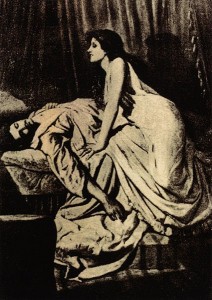
The VampireVampire stories helped explain death in the 19th century

Stories can be a potent method for trying to make sense of the inexplicable. Basic story structure—beginning, middle, end-is such an effective way to organize events that we often use it to carve meaning out of what would otherwise be random or chaotic occurrences.

It seems to me it’s easy to forget this point in an organizational setting where, when stories are elicited, they are assumed to be coherent.

Continue reading

Posted in: Uncategorized Tags: ,