tag archive: intercultural communication

7 Necessary Narratives for the New Digital Age

In the future, nearly everyone will be connected to the Internet and to each other, claim Jared Cohen and Eric Schmidt in The New Digital Age.

Mass connectivity will transform our relationships, our governments, our work, our bodies and the objects around us. But even these dramatic transformations will not change the fact that we are corporeal creatures, and that we will still live lives grounded in phnew digital agephysical circumstances, whether those are urban or rural, rich or poor, lucky or unlucky.

We will also come into the world with a set of inherited stories about who we are, what our lives mean, and what the future looks like. These stories will have the same universal threads they always have: we will still have stories of love, stories of family, stories that try reconcile life’s fundamental unfairness. But they will also fail in important ways to explain the transformations of our lives, and the new ways in which we will do old things.

We need new stories

We need new stories. Creating them is of necessity not only a collective task, but a transnational one. As we grow even more connected, we also grow more capable of exporting our ideas about who we are and what is important on others, wherever they are. Yesterday, two Nigeria-descended men hacked a third to death on a London street, and then stayed on the scene to tell how they saw themselves in a world at war: “We must fight them as they fight us.” As we grow more connected, and more willing to share our selves with others, maybe pernicious forms of shame—that universal emotion—will be knocked out, and we’ll be more healthy.

It all depends on how we decide to tell our future. Here are seven of the areas where we will need new stories in the new digital age, as described by Schmidt and Cohen.


7 Necessary Narratives for the New Digital Age

1. The Body

Both religion and science fiction have long dreamed of worlds in which humans transcend bodies, to become virtual souls. In the new digital world, however, we will shape our identities online but experience them in the physical world. How will we understand health and illness, and mortality, if we have the capacity to monitor our daily rhythms in minute ways?

2. Personal Identity

Schmidt and Cohen tell us that identity will be each of our most valuable commodity in the future, and that our true personal identity will be the one that we shape online.

How will we choose to tell our life stories and in what ways will the autobiographical form change in a world in which there is essentially no privacy? Where will we think our “real” self resides. Where will the associations with privacy as a space of intimacy, daydreaming, erasable exploration, unrecorded experimentation with who we are, in order to practice who we could be, relocate, when we have no privacy?

3. News

Our concepts of journalism and news reporting have already undergone dramatic changes; journalism has become in many ways a collective task that falls to professional reporters and citizens alike, and to groups and organizations that put out versions of the news that support particular causes or points of view.

As an increasing number of voices join in the journalistic task, the work of professional media will evolve. The media might become a trusted validator of unsubstantiated accounts, or an integrator of news from different kinds of sources. The value of objectivity may fade, while versions of what subjective news that maintains its integrity will emerge—this will be the new narrative of news.

4. Cybersecurity

Different forms of public security – whether they are in the arena of health, or counterterrorism, or child safety – operate according to different metaphors, storylines and images. Those around cyber-security may coalesce around metaphors of health and hygiene: we are told to practice “cyber-hygiene.

Schmidt and Cohen introduce Microsoft Chief Research and Strategy Officer, who has also recommended a “World Health Organization” for cyber-activity, and the practice of quarantining computers that have been infected with viruses. As Adriane Lapointe, a National Security Agency official has observed, the public health metaphor may serve as the basis for a meaningful public narrative:

Like any good metaphor, it invites us to consider illuminating similarities between two overtly dissimilar things—malware on the internet and infectious disease in a community—similarities that can lead us to reframe a familiar topic. It also identifies a policy precedent, reminding us that we do, as a society, recognize the need to impose some restrictions on individuals who involuntarily pose a certain kind of threat to others, and that we have a mechanism to do this which might be relevant to cybersecurity matters. Whether we ultimately decide that this mechanism or approach is appropriate to the cyber challenge, the metaphor has certainly helped to broaden thinking about the subject.

5. National Identity

The nation-state has been the bedrock of our civic identities for the last couple of centuries, and the idea that every nation deserves its own territorial state a driving narrative of the 20th century. But new diasporas resulting from increased migration, coupled with digital connectivity, are decoupling the nation from the state, creating virtual, de-territorialized nations.

How will a de-territorialized nation narrate its future? How will cultural practices that have been grounded in place be translated into practices of other place? Will other forms of bonding, such as investment in the home country, become a standard part of an individual’s narrative of their national identity? Will the idea of a relationship to a particular land wither for some communities, and if so, to what effect?

6. Dissident Leadership

There is much to protest in this world, and the low cost of entry to share dissident views will lead to a widening number of protestors seeking attention for their cause. Many of these causes will be worthy and compelling, so it is no longer enough to offer the platitude the most persuasive stories will gain our attention. Rather, we—the public that dissidents must win over-may begin to change the meta-story, or standards, by which we evaluate leaders and causes.

Schmidt and Cohen offer that dissident leaders likely to become popular will be able to: “command a following and crowd-source their online support,” will know how to exploit digital marketing tools, and will show their commitment by putting themselves at physical risk.

We can already guess that digital marketing skills are not the most important skills for someone seeking a leadership role in a dissident setting. We can use this recognition starting now to inoculate ourselves against easily accepting simply the most digitally skilled. We can ask, instead, what are the qualities—what is the story—of a leader who is likely to be successful, who understands the institutions they want to change, and lead that change on the ground as well as in virtual space.

7. Justice

Cameras in our smallest devices make it easy to record the human capacity for barbarism in its many forms. Violence, sexual assault, cruelty to animals, hate speech all find their way into digital form on a regular basis, easily arousing our instinctual repugnance. As Schmidt and Cohen observe, these recordings can become the basis for “crowd sourced justice,” which may take the form of mob retaliation, from harassment to violence.

But we could instead form new habits of collective responsibility—using our connectivity to make sure that those who commit bad acts are dealt with according to our legal precepts and best values, and to explore together how to deal with bad behavior at the community level. Which narrative, and which set of practices that prevail, depend on how we decide to narrate our opportunity to ‘crowd source justice,’ which behaviors we highlight and celebrate, and how we talk about what we see online.

Posted in: Books & Films, Intercultural Communication, International Politics, Marketing & Branding, Popular Culture, Public Relations Tags: , , , , , , ,

Post-Boston: A More Effective Battle of Ideas (Part II)

Boston MarathonReprinted from The Globalist, April 24, 2013

Instead of getting sucked into heat-of-the-moment reactions to Boston, let’s base our responses on a more stable paradigm of contemporary global terrorism. To fight a battle of ideas successfully, one must first show what one is going up against. Amy Zalman makes the case that there are three distinct trends in terrorism — Hybrid, Multi-motivational and Narrative Terrorism.

This paradigm is evolving, but several trends are coming into view and are likely to deepen in the future:

  • Hybrid terrorism:

In traditional categorization of terrorists, there are “lone wolves” who are unconnected to any organized group and those who are members of organizations.

Today, a hybrid type appears to be evolving: someone who works without full organizational support or direction, but who is not working in total isolation from others. Continue reading

Posted in: Crisis Management, Intercultural Communication, International Politics, News and Journalism, Political Analysis, Politics and Policy, Strategic Leadership, War and Violent Conflict Tags: , , , , , , , , ,

Resilience Narratives Key to Resilient Systems

The 2013 World Economic Forum Conference that began today in Davos is dedicated this year to resilient dynamism. As Arianna Huffington noted earlier in the day, the key concept that gives rise to the need for resilience is our global interconnectedness. Quoting Rockefeller Foundation President Judith Rodin, she cites five attributes that resilient systems characteristically share:

  • Spare capacity
  • Flexibility — the ability to change, evolve, and adapt in the face of disaster.
  • Limited or “safe” failure, which prevents failures from rippling across systems.
  • Rapid rebound — the capacity to reestablish function and avoid long-term disruptions.
  • Constant learning, with robust feedback loops.

Huffington adds a sixth, “the will to want to be resilient.”

To that list, I feel we must add a seventh requirement for the present and future, Resilience Narratives: stories that will help disparate and potentially adversarial players see themselves as active participants in collaborative futures. Continue reading

Posted in: Conferences, Crisis Management, Decision making, Intercultural Communication, International Politics, Politics and Policy, Strategic Communication, Strategic Leadership Tags: , , , , , , , , , ,

The Need for a New Story: Faizullah Jan Compares Narratives of the U.S. Drone War in Waziristan

The narratives told in Pakistan and by international organizations about the secret U.S. drone war in Waziristan are so confused that “the people who are caught in the crosshairs of the war have lost their voice and their story to tell.” In this guest blog, reprinted from Dawn.com, Jan explains the issues.

Reprinted from Dawn.com

January 5, 2013 by Faizullah Jan

THERE are competing narratives about the US’s drone war in the Waziristan area, a bastion of militants. These narratives have so far failed to gain traction in the public, inside Pakistan and elsewhere.

The Pakistani narrative goes like this: the drone attacks are a violation of our national sovereignty. They kill innocent people, including women and children, as collateral damage and hence incite suicide attacks across the country in a cycle of reprisal and retaliation, thus killing more Pakistanis, which again includes women and children.

In short, suicide attacks on public places like markets — and even mosques and shrines — are provoked by drone attacks. If there are no drone attacks, there will be no suicide attacks in cities and towns. Continue reading

Posted in: Guest posts, Intercultural Communication, International Politics, National Security, News and Journalism, Political Analysis Tags: , , , ,

Narrative for Survival: My Grandmother’s Story

Stories can save lives. In One Thousand and One Nights, Sheherezade uses her storytelling talents to end King Shahrayr’s plot to punish his unfaithful wife by punishing all of the women of his kingdom. Having put to death the unfaithful Queen herself, the King embarks on a plan to marry a virgin of the Kingdom each night, and to have each killed at dawn. That is, until he marries Sheherezade, who spends her wedding night narrating to the King a most exciting and suspenseful tale. So exciting that the King puts off her death to hear how the story continues. And so their story continues for a thousand and one nights, after which the King abandons his goal to punish women, and marries Sheherezade.

My grandmother may not have had a thousand stories, but she had at least one, and telling it to an American Consul in 1939 saved her life and that of her husband and baby, when it permitted her to leave warring Europe on one of the last ships to cross the Atlantic. I had the opportunity to tell it at a local TedX event earlier this year, and was delighted when TEDx organizers chose it as one of their favorites. I’d love to hear about other stories that have saved lives, if you have one you’d like to share.

Posted in: Books & Films, Intercultural Communication, International Politics, Narrative forms, Politics and Policy, Popular Culture, War and Violent Conflict Tags: , , , , , , , , , ,

Intertextuality for Strategic Communication

The Power of Reference, Allusion and Quotation in Communication

Two recent films, Skyfall and Anna Karenina, are made more intensely meaningful by their intentional intertextuality-their incorporation of previous iterations and interpretations of the story they are themselves telling. Both offer insights into the ways communicators can benefit from the same kind of internal referentiality.

The Concept of Intertextuality

Literary and linguistic theorists began to work with the concept of intertextuality in the mid-1960s, when theorist Julia Kristeva coined the term. Scholarly definitions have proliferated and grown increasingly technical in the intervening half century. For our purposes, the following definition works just fine: Intertextuality means that texts – novels, paintings, films, but also tax codes and thank you letters –gain meaning not through their reference to an external reality, but by their reference to pre-existing other texts. Intertextuality is not a choice, but rather an inevitable by- product of creating, because we are always creating into already existing histories, discourses and ways of interpreting. These existing frames have already partly shaped what we will produce and how it will be recieved. An author or an artist may intend to give us something original, but they can’t, fully. We readers, in turn, never have direct access to a work, but can only get at it by making our way through its prior iterations and interpretations.

James Bond and Anna Karenina are among the most iconic popular texts in modern Western culture. The James Bond series, which is the longest-running film series in history, has given us the rules by which we define spy thrillers. Anna Karenina is no longer only the Leo Tolstoy novel, but also the dozens of derivative films, ballets, operas and musicals that have been created since the late 19th century.

Both are completely enmeshed in our everyday language — we think things about ourselves through the mesh of their expressions:“Bond, James Bond,” and “Shaken, not stirred,”are shorthand invocations of suave masculinity. “All happy families are alike, but each unhappy family is unhappy in its own way,” has become a catch-all syntax for describing the singularity of just about anything, including in statistics, where the “Anna Karenina principle” is applied to ecological and economic puzzles.

Semiotics professor Daniel Chandler explains the implications of intertextuality: Continue reading

Posted in: Books & Films, Intercultural Communication, Marketing & Branding, Narrative forms, Popular Culture, Public Relations, Strategic Communication Tags: , , , , , , ,

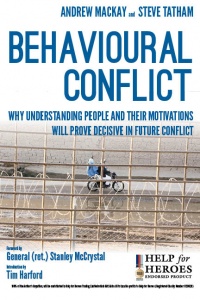
Behavioral Economics Go to War

Review of Behavioural Conflict, Why Understanding People and their Motivations Will Prove Decisive in Future Conflict, by Andrew Mackey and Steve Tatham

I cannot think of any books about warfare’s future that come across as hard-hitting, full of actionable pragmatism, and deeply humane all at the same time. But Behavioral Conflict: Why Understanding People and their Motivations will Prove Decisive in Future Conflict is all three. The authors, both career members of the British military, Major General Andres Mackey (Ret) and Royal Navy Commander Steve Tatham (who I count as a friend, having met him in Ankara a few years ago), make their case by drawing on a combination of their own experience, case studies and close analysis of how communication actually factors in war.

Hard-hitting and pragmatic: Mackey and Tatham are precise and lucid about what they mean by “behavior” and how to make use of it to gain advantage in conflict. They, and behavioral psychologist Lee Rowland, who adds a chapter on the science of influence, are not putting forth any of the following: A call for greater “cultural awareness,” a mushy program about how to change others’ attitudes, or a repeat of the last decade’s focus on consumer marketing as the key to public diplomacy. They offer instead this thesis based on a simple chain of claims:

  • The world of human motivation and perception is inevitably complex.
  • It is more important to try to shape behavior than it is to change people’s attitudes.
  • Behavior shaping begins with a discrete grasp of the circumstances under which people already behave in ways that are desirable, and extends to efforts to replicate those or similar circumstances. Continue reading

Posted in: Books & Films, Decision making, Intercultural Communication, International Politics, Narrative Research, National Security, Politics and Policy, Strategic Leadership, War and Violent Conflict Tags: , , , , , , , , , , , , , , ,

High Powered Collaboration, a New Narrative for Leaders: an Interview with Kare Anderson

Kare Anderson Coaches Leaders to Get from "Me to We"

Kare Anderson has been a leader in communication in virtually every medium there is for over 30 years. She is an Emmy-winning former Wall Street Journal and NBC reporter, the author of a number of books about conflict resolution and collaboration in business, and publishes the online newsletters Moving from Me to We and Say it Better.

Kare’s most powerful communications though, come through in her coaching. She has led issue teams for the Obama 2008 campaign, advised CEOs, professional athletes, and cause advocates. All seek to have their story heard in highly competitive environments.

When we met recently, I immediately knew I’d like to interview Kare about how she uses narrative in her practice. In our few minutes on the phone last week, she offered concise wisdom and specific strategies for using collaborative techniques to achieve preferred outcomes—no small feat in a complex, noisy world.

AZ: How does storytelling and narrative play a role in your coaching?


KA
: For me one of the most difficult things is that people instinctively talk about themselves. When they’re standing on the stage talking to their employees, they talk about their company; they don’t talk about what’s in it for the employees. Many times when people are trying to tell their story they miss the biggest part, which is to construct it so it’s a purposeful narrative-so that the listener can see a role for themselves, want to jump in, retell it and play a role in it. When I think about storytelling, it is to understand what a person most stands for, what they want to get across and how they can authentically discuss it with someone elsewhere that person wants to jump in. The instinct is for people to ask a question and revert it back to themselves. Even when they want something from someone else. Continue reading

Posted in: Crisis Management, Decision making, Intercultural Communication, Narrative and Cognition, Public Relations, Strategic Leadership Tags: , , , , , ,

Announcement: U.S. State Department Strategic Narratives Public Meeting

At the RAND Corporation in Santa Monica, CA, November 29

From the State Department Announcement:

The U.S. Advisory Commission on Public Diplomacy will hold a public meeting on the topic of strategic narratives November 29, 2011, in Santa Monica, CA, in partnership with the RAND Corporation. The meeting will take place at the RAND offices at 1776 Main Street in Santa Monica, CA, in the Forum Auditorium. It will begin at 9:00 am and end at 3:00 p.m. with doors open for registration and continental breakfast at 8:30 a.m. The event will be webcast live and will emphasize open-forum question and response periods with the audience.

To attend, contact the RAND Corporation no later than November 21 by phone at (412)683-2300 ext 4906 or email to [email protected] and provide your full name, citizenship (U.S. citizenship is not required to attend), and institutional/organizational affiliation. Continue reading

Posted in: Conferences, Narrative Research, National Security, Politics and Policy, Public Diplomacy, War and Violent Conflict Tags: , , , , , , , , ,

Afghanistan Narrative, Still Wrong, but Reparable

Earlier this month, Benjamin Hopkins and Magnus Marsden, authors of the forthcoming Fragments of the Afghan Frontier, argued strenuously in a New York Times Op Ed that the U.S. strategy in Afghanistan is as culturally inept as it was when we went to war a decade ago. The American obsession with viewing Afghanistan though the lens of tribal tradition is borrowed from 19th century Brits, whose understanding tribal mores was in large part composed of fanciful inventions of their own. Above all:

Afghanistan is not a country of primitive tribes cut off from the modern world. The singular focus on tribes, the Taliban, and ethnicity as the keys to understanding and resolving the conflict misses the nuances of the region’s past and present. Rather than fanatical tribesmen or poor victims in need of aid, many of these people are active and capable participants in a globalized economy.

http://navylive.dodlive.mil/index.php/2010/10/19/issues-of-the-veil/#disqus_thread

The U.S. military addresses cultural issues, even in how to dress**

Why does this profound institutional failure persist? I read it and hear versions of the premise that Afghans don’t live in the same globalized world as Americans all the time in defense contexts. The fact that it does persist should give us deep pause about how resources have been expended to create a more ‘culturally aware’ national security community. Continue reading

Posted in: Intercultural Communication, International Politics, Middle East, Narrative and Cognition, Narrative Research, National Security, Political Analysis, Politics and Policy, War and Violent Conflict Tags: , , , , , , , , ,