
tag archive: globalization

Egypt Uprising Narrative as Youth, New Media Driven: Wrong

Ala' 'Abd al Fatah (image courtesy of Wikimedia and Manalaa.net under Creative Commons license)

NPR’s Michele Norris interviewed Egyptian blogger and software Ala’ ‘Abd Al Fattah on June 6 about his role and perceptions of the uprising in Egypt that brought down the Mubarak regime earlier this spring. Among Al Fattah’s insights: the narrative of events in Egypt as a primarily youth led and Internet driven and urban are incorrect. As he notes: “by that exclusion you also exclude a very big aspect of what it is about.”

NORRIS: You’re here in this country in part to describe what happened in Egypt. Are there things that happened there that people don’t well understand? Here, when there are large uprisings or large news events like this, a popular narrative takes hold and sometimes it’s correct and sometimes it’s not completely correct.

Mr. AL FATTAH: I think a lot of it is misunderstood and misrepresented in both internationally and even locally from the framing of this as an Internet-led revolution to a framing that it’s a youth revolution. All of that is based on the aspects of reality, but it excludes the majority of the people who participated in the revolution.

And by that exclusion, you also exclude a very big aspect of what it is about. And also, there’s a lot of focus on Tahrir while you had the majority of the revolution was happening outside of Cairo. And some of its most amazing stories were in - there were six towns that were completely autonomous after the third day of the uprising, and people had to manage the cities and had to organize themselves to keep the cities functioning. And that experience is amazing, and it’s not really being discussed.

Two important questions flow from al Fattah’s interesting observations. One is about what is left out of the popular narrative of the uprising as high tech and youth driven. And the second question is why? What is the function of the high tech narrative?

One kind of answer is supplied by Mona el-Ghobashy. Writing in Middle East Report earlier this spring, the Barnard political science professor outlines “the reality … that Egyptians had been practicing collective action for at least a decade” preceding the 2011 events, although their increasing political sophistication was repeatedly characterized as the effect of economic pain Egyptian officials. While social media and mobile phones enabled the synchronization of protests on January 25, it was this ‘invisible’ history that shaped a people capable of such effective demonstrations they toppled a police regime.

As for why the high tech, youth driven narrative holds such sway in Western media: To a degree it reflects a kind of vanity we hold about ourselves. In the United States, in particular, it is hard for us to imagine political sophistication in parts of the world we do not know well, or what it looks like. So we imagine revolutions in the image of ourselves we like best: as an eternally young (vis-a-vis Europe) country whose technologies have enabled and inspired the rest of the world. In one version of the Egyptian uprising, we see a satisfying reflection of the kind of revolution we would have liked to inspire.


Posted in: Intercultural Communication, International Politics, Middle East, Political Analysis, Politics and Policy, War and Violent Conflict Tags: , , , , , ,

NY Times tells the Story of the Story of Obama’s Mideast Speech

Official_portrait_of_Barack_Obama

The degree to which communication’s globalization has changed the way we think and talk about the news is evident in today’s reporting on Obama’s Middle East speech. Once upon a time, communication-via newspaper, radio, what have you—was considered a transparent vehicle conveying to readers and listeners what was happening on the ground.

Not so any longer. Now we are in full postmodern swing and “the news” highlights not only things that happen in the world (like presidential speeches), but how they are worded, and who these words are supposed to impact, and how different audiences may interpret what is said. The fact is that these elements of communication always mattered, but the speed and visibility of our interactions with those elements has helped press into relief the degree to which they play a part in how events themselves (like peace talks, political decisions, elections, wars) unfold. All of this made the concept of narrative more important—narrative is the elements of communication in action, all working together on a jointly constructed story of events unfolding in real time, and it also the interplay of that construction with events themselves. Continue reading

Posted in: International Politics, Middle East, National Security, Political Analysis, Politics and Policy Tags: , , , ,

How to Market an Unpopular Cause

Kosovo Albanian ethnic costume/dance, courtesy of Wikimedia

Kosovo Albanian ethnic costume/dance, courtesy of Wikimedia

How do you market an unpopular cause?

In a world crowded with attention-worthy causes, why do some get the backing of the international community, while others languish? This good question is being asked by the recipients of this year’s Hope Fellowship, a fund established by the National Albanian American Council to strengthen the role of women in policy and decision-making in the Balkans. They are seeking recognition for their largely unrecognized country, Kosovo, which split off from Serbia and declared independence in 2008. In order to help them in an upcoming training session, I went looking for new models that might help structure the challenge of making their so-far-unpopular country more widely understood in the European Union and beyond.

There are no easy models or quick fixes for a people seeking to establish a legitimate identity among other nations, as Kurds and Palestinians well know. And an over focus on media and message dissemination (should we have a Facebook page? How many radio stations?) while important, is no replacement for the deeper work of developing a national identity story that resonates in international channels.

While seeking models, I found two excellent books that shed light on how embattled causes get attention from the international community. Although they are both specific to politics, they offer valuable insights for any organization seeking to make an impact on another.The Marketing of Rebellion: Insurgents, Media and International Activisim by
Clifford Bob has been highly regarded since its publication in 2005.

Bob seeks to answer the question: “How do a few political movements challenging Third World states become global causes célèbres, whereas most remain isolated and obscure? He answers answers by looking through the dual lens of marketing and globalization. The marketing perspective, as he puts it, “denies that there is a meritocracy of suffering,” in which NGO backing and international sympathy lie—as we would hope—with the best causes. Instead, “local movements insistently court overseas backing, and their promotional strategies count.” Continue reading

Posted in: Books & Films, International Politics, Marketing & Branding, Public Diplomacy Tags: , , , , , , ,

SIETAR Conference on Intercultural Communication Begins Today in Denver

The Eleventh Annual Society for Intercultural Education Training and Research (SIETAR) Conference begins today in Denver. This year’s conference is dedicated to the topic of “Risk and Resilience in an Intercultural World.” In crisis, or other adverse circumstances, reaching across cultural borders can appear to be unduly risky, and it is resilience—the ability to recover from adversity—that must be cultivated if we are to remain engaged with others
SIETAR is a membership organization with satellite groups throughout the United States and abroad. Founded in 1974, the organization was created:

To provide a forum for exchanging ideas about training, theory, and research, and to learn from each other as well as to provide a place where interculturalists could strengthen their bonds with each other. They envisioned an exchange between people in different disciplines and professional activity that would strengthen the theoretical development and practice of intercultural communication.

Keynote speakers include Dr. Todd Conklin, Dr. William Cross and Dr. Pari Namazie. Conklin is a specialist in human error and safety at the Los Alamos National Laboratory in Santa Fe, New Mexico, and the other of an upbeat book on Simple Revolutionary Acts to make ourselves more engaged, happier workers. Cross heads the Social-Personality Psychology subprogram at the City University of New York Graduate Center. Cross is well known for his work on African-American identity, and particularly for his 1991 book Shades of Black: Diversity in African American Identity Namazie works in the field of international human relations management and intercultural management. She is the managing director Atieh International, a strategy, HR and training company focusing on developing business opportunities between the Middle East and Europe.

Posted in: Conferences, Crisis Management, Intercultural Communication Tags: , , , , ,

Egypt Narrative Promises a Long Unfolding

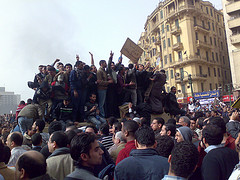
The story of the Egyptian demonstrations continues to unfold (photograph courtesy of Rami Raoof under Creative Commons license)

The story of the Egyptian demonstrations continues to unfold (photograph courtesy of Rami Raoof under Creative Commons license)

The current events unfolding in Cairo offer little in the way of narrative comfort. Instead, news commentators, analysts, even participants—weighing in breathlessly from the street on Twitter or Al Jazeera—seem struck by ambiguous meaning of events. Is looting spontaneous or sponsored by the Mubarak government to provoke requests for government protection? There are no clear successors to a Mubarak government, and no clear mechanism for a non-military succession. Why have the police abandoned the protests?

Continue reading

Posted in: Intercultural Communication, International Politics, Middle East, National Security, Political Analysis, War and Violent Conflict Tags: , , ,

Body Scanners Expand the State’s Boundaries

bodd scanner

The recent flap over the TSA security measures –both manual pat-downs and backscatter x-ray and millimeter wave scanners—has been painted as presenting a conflict between personal privacy and national security.

We might more accurately call it a conflict over boundaries, personal and national. Who has the right to cross what borders? What is the proper boundary between my body and the state?

This trope, which is also present in other conflicts, like that over abortion, is particularly apt in a battle against terrorism. Boundaries, after all, are precisely what terrorists violate. Violent actors’ capacity to terrorize originates in their readiness to transgress both physical and moral boundaries. The more flagrant the violation, the more terrified we become. Terrorists do not obey the agreed on boundaries of sovereign states, nor those that we—the global community—have sanctioned to regulate war: we draw boundaries between just causes for war and unreasonable ones and, crucially, between combatants and civilians. The line between combatant and civilian in war is sacrosanct to most of us; on one side, we go toward injury, on the other, we are to be protected from it.

Perhaps it is the nature of this particular conflict that has led to a peculiar focus by the United States on bodies and boundaries, an intersection that is often shadowed by the erotic, whether for good or ill.

There is the ongoing confusion over whether others are combatants are civilians. We do not know where to draw the line. If you were an Afghan, or even a non-Afghan, in the orbit of Al Qaeda in 2001, did that make you a terrorist? Continue reading

Posted in: National Security, Politics and Policy, War and Violent Conflict Tags: , , , , ,

The danger of a single story

Nigerian novelist Chimamanda Adichie talks about “the danger of a single story:” what happens when a single narrative about a people or place dominates our imagination. For Adichie, it meant she was greeted on arrival in the United States for college with disbelief that the middle class professor’s daughter was authentically African—she was not tribal enough, and was neither starving nor HIV-ridden.

“The single story creates stereotypes and the problem with stereotypes is not that they are untrue, but that they are incomplete. They make one story become the only story.”

Thanks to Michael Paone of the New York City Coalition against Hunger for passing it on.

Posted in: Books & Films, Intercultural Communication, International Politics, Uncategorized Tags: , , ,