Has the Eurozone crisis led to a loss of European Union power?
Washington D.C. was even more full of diplomatic cars and dark suited men than usual this weekend, as the the World Bank and International Monetary Fund held their annual spring meetings. Historically dedicated to shoring up ‘developing’ regions, this year’s focus was on the Eurozone crisis, that ongoing ripple of effects from the near financial collapse of several EU countries.
Some policy makers think that the EU’s loss of economic power will reduce its power on other issues, as the New York Times has reported: Continue reading
In an earlier post, I outlined ways in which the term strategic narrative is used in current practice, in public relations—as an element of marketing—and in the academic field of international relations. This post returns to the evolution of the term as an applied concept in foreign affairs.
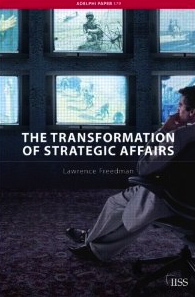
According to International Relations professor Alister Miskimmon (who I asked by email), the first published use of the term “strategic narrative” was by Lawrence Freedman, a professor of War Studies at King’s College, London. In 2006, Freedman wrote a paper called The Transformation of Strategic Affairs. Many of the insights in Freedman’s work stem from the Western experience of war in the post-9/11 years, and the discovery—the hard way, through experience—that the era of large scale land warfare may be decisively over. In its place, the future promises smaller wars, waged by insurgents as well as governments, in which human factors such as behavior, culture and communication play meaningful roles.
In this context, Freedman identifies “strategic narratives” as a kind of secret weapon of networked combatants fighting irregular wars. In Freedman’s view, a story that connects people emotionally to an identity and a mission “helps dispersed groups to cohere and guides its strategy. Individuals know the sort of action expected of them and the message to be conveyed.”
Thus, in Freedman’s definition, narrative is a function of strategy in the most traditional sense related to the science of war. In that vein, he argues that: Continue reading
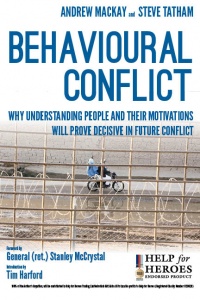
Review of Behavioural Conflict, Why Understanding People and their Motivations Will Prove Decisive in Future Conflict, by Andrew Mackey and Steve Tatham
I cannot think of any books about warfare’s future that come across as hard-hitting, full of actionable pragmatism, and deeply humane all at the same time. But Behavioral Conflict: Why Understanding People and their Motivations will Prove Decisive in Future Conflict is all three. The authors, both career members of the British military, Major General Andres Mackey (Ret) and Royal Navy Commander Steve Tatham (who I count as a friend, having met him in Ankara a few years ago), make their case by drawing on a combination of their own experience, case studies and close analysis of how communication actually factors in war.
Hard-hitting and pragmatic: Mackey and Tatham are precise and lucid about what they mean by “behavior” and how to make use of it to gain advantage in conflict. They, and behavioral psychologist Lee Rowland, who adds a chapter on the science of influence, are not putting forth any of the following: A call for greater “cultural awareness,” a mushy program about how to change others’ attitudes, or a repeat of the last decade’s focus on consumer marketing as the key to public diplomacy. They offer instead this thesis based on a simple chain of claims:
The world of human motivation and perception is inevitably complex.
It is more important to try to shape behavior than it is to change people’s attitudes.
Behavior shaping begins with a discrete grasp of the circumstances under which people already behave in ways that are desirable, and extends to efforts to replicate those or similar circumstances. Continue reading
E.M. Forster famously distinguished events that are yoked only by their temporal order from those that we would consider a narrative (which he called “plot”), in which events are causally linked, with this pithy comparison:
1. The King died and then the Queen died (2 events tied only by temporal order)
2. The King died and then the Queen died of grief (the second event is caused by the first)
I’ve had this distinction on my mind as year-end wrap-ups circulate in the media.
Protestors on Wall Street, September 30, 2011
The global scope of economic crisis and dramatic protests give commentators a lot of latitude to tell the story of this year in a variety of ways. Did Mohamed Bouazizi’s galvanizing protest by fire, and the subsequent fall of the Tunisian government cause Egyptian protests? And did these, in some way cause Occupy Wall Street? Do the protests in Chile, Tel Aviv and Russia have anything to do with each other, or with others? Continue reading
At the RAND Corporation in Santa Monica, CA, November 29
From the State Department Announcement:
The U.S. Advisory Commission on Public Diplomacy will hold a public meeting on the topic of strategic narratives November 29, 2011, in Santa Monica, CA, in partnership with the RAND Corporation. The meeting will take place at the RAND offices at 1776 Main Street in Santa Monica, CA, in the Forum Auditorium. It will begin at 9:00 am and end at 3:00 p.m. with doors open for registration and continental breakfast at 8:30 a.m. The event will be webcast live and will emphasize open-forum question and response periods with the audience.
To attend, contact the RAND Corporation no later than November 21 by phone at (412)683-2300 ext 4906 or email to maria_falvo@rand.org and provide your full name, citizenship (U.S. citizenship is not required to attend), and institutional/organizational affiliation. Continue reading
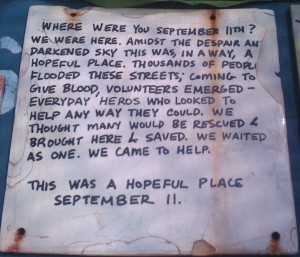
Tile made as part of a project that let people create their own commemorative tiles in 2001; they were later hung on a chain link fence in New York City's Greenwich Village (photo A. Zalman)
Patriotism—love of one’s country—is a treacherous emotion. Too little of it, and we aren’t motivated to make necessary sacrifices on behalf of our national brothers and sisters. Too much of it, or too much of the wrong sort, and exclusionary nationalism—in the form of various ethnic and religious hatreds- takes over. The challenges of getting patriotism right people think that we should avoid these dangers and keep emotion out of our public lives, substituting instead our critical faculties to reason our way to being fair and kind to each other.
But, as philosopher Martha Nussbaum argues, we require this form of love, “distinct from simple approval, or commitment or embrace of principles” in order to act on behalf of people we have never met—those people invoked by the idea of nation. Continue reading
The competing narrative continuing to unfold about the ongoing violence in Syria reflect how completely amateur video has now transformed our understanding of what “news” is. Activists’ homemade videos have shattered the idea that the Syrian government’s claim to be restoring “stability” to towns under attack from “armed terrorists” can be taken at face value.
Yet, amateur videos cannot be verified easily, and for that reason also cannot be taken at face value. In order to try to tell the “whole” story, Reuters, CNN and other mainstream sources seem to be frequently reduced to a version of stuttering about how, although they are showing citizen footage, they can’t vouch for it’s accuracy. The New Yorker, commenting on an August 5th video below, notes that, “Like all of the amateur videos coming out of Syria, where the foreign press has been banned, this footage has not been independently verified.”
Other journalists, like Dissected News founder James Miller, are rewriting the terms of journalistic objectivity to try to make sense of, and verify, amateur video claims. Like traditional journalism, this new form requires a zealous desire get the story right and the passion-and knowledge of context-to uncover truth. But it also requires the talents of a film critic—the ability to read images, to interrogate pictures for what they reveal and conceal, and to explore how they are constructed.
As it turns out, a picture is not worth a thousand words at all. A picture is just like words – it may tell the truth, it may deceive, but it is never the transparent conduit to fact we once thought it was. It is up to good journalists to decipher them, and learn to read them as they do sources’ statements: as complex, layered signals that say as much about the worldview of the people making them, as they do about events at hand.
… Some news agencies have occasionally been duped by propaganda promoted by individual “activists”, but those observers who are more tuned in, after months of experience, to the claims of the activists, now know which individuals or groups produce credible information, and they know when to be extra-skeptical about reports. However, many of these claims are reliable, and the media who drop in on the Syria story need to pay attention to the journalists who are working hard to separate the “good” reports from the “bad”. Because in Syria — to take a position — one side is lying, one side is mostly truthful, and thousands of lives are in the balance of the two.
Mary Crannell is one of those people whose broad intelligence and enthusiasm are hard to contain, as I learned when we met recently through a shared acquaintance. As the president of Idea Sciences, a decision-making support consultancy based in Alexandria, VA, Mary spends much of her time thinking about what technologies and processes will help her customers—such as the IMF, NATO, QinetiQ, the US Army, the UK Army, Verizon and Herman Miller, to name a few—arrive at good decisions. She is a frequent traveler to sites of conflict, as in a recent visit to Kabul, Afghanistan, where decision-making is an urgent, complex and ongoing task.
I was gratified when Mary agreed to share some of her thoughts on the role of narrative in decision-making generally, and in directing the American role in the world in productive directions, which is a concern many of her clients share.
Mary Crannell, President, Idea Sciences
AZ: How do you use narrative frameworks to help people make decisions?
MC: It is important to give people a way to define the vision of what they are trying to accomplish whether they are leading a state, a nation or an international organization. Is the system you are leading “on purpose?” We start with a vision. Continue reading
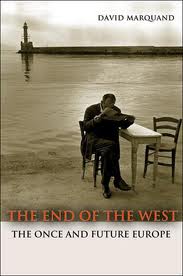
Marquand’s thesis is that changing global circumstances press into relief both unresolved ambiguities that now must be resolved if the European Union is to continue as a viable institution. The creators of the European Community were eager to forge the organization, and to feel they were beginning to put the outrages of hyper-nationalism, in Nazism and fascism, and the ethnic hatreds exemplified by the Holocaust behind them. These terrible events stood in sharp contrast to the modern Western self-ideal: rational, egalitarian, and humanist, rather than racially minded, and the European Community was a way to return Europe to that better model of itself.
As a result of this fervor to move beyond the horrors of World War II, the founders of the European Community (later the European Union) never explored ambiguities regarding the implications of being “European.” These included complex issues of ethnic identity vis-à-vis national and European identity, the degree to which supranational governance would override the national sovereignty of member countries, and basic questions about geography—what are the territorial boundaries of Europe, and are they identical with some sort of defining quality of Europeanness? Continue reading
Ala' 'Abd al Fatah (image courtesy of Wikimedia and Manalaa.net under Creative Commons license)
NPR’s Michele Norris interviewed Egyptian blogger and software Ala’ ‘Abd Al Fattah on June 6 about his role and perceptions of the uprising in Egypt that brought down the Mubarak regime earlier this spring. Among Al Fattah’s insights: the narrative of events in Egypt as a primarily youth led and Internet driven and urban are incorrect. As he notes: “by that exclusion you also exclude a very big aspect of what it is about.”
NORRIS: You’re here in this country in part to describe what happened in Egypt. Are there things that happened there that people don’t well understand? Here, when there are large uprisings or large news events like this, a popular narrative takes hold and sometimes it’s correct and sometimes it’s not completely correct.
Mr. AL FATTAH: I think a lot of it is misunderstood and misrepresented in both internationally and even locally from the framing of this as an Internet-led revolution to a framing that it’s a youth revolution. All of that is based on the aspects of reality, but it excludes the majority of the people who participated in the revolution.
And by that exclusion, you also exclude a very big aspect of what it is about. And also, there’s a lot of focus on Tahrir while you had the majority of the revolution was happening outside of Cairo. And some of its most amazing stories were in - there were six towns that were completely autonomous after the third day of the uprising, and people had to manage the cities and had to organize themselves to keep the cities functioning. And that experience is amazing, and it’s not really being discussed.
Two important questions flow from al Fattah’s interesting observations. One is about what is left out of the popular narrative of the uprising as high tech and youth driven. And the second question is why? What is the function of the high tech narrative?
One kind of answer is supplied by Mona el-Ghobashy. Writing in Middle East Report earlier this spring, the Barnard political science professor outlines “the reality … that Egyptians had been practicing collective action for at least a decade” preceding the 2011 events, although their increasing political sophistication was repeatedly characterized as the effect of economic pain Egyptian officials. While social media and mobile phones enabled the synchronization of protests on January 25, it was this ‘invisible’ history that shaped a people capable of such effective demonstrations they toppled a police regime.
As for why the high tech, youth driven narrative holds such sway in Western media: To a degree it reflects a kind of vanity we hold about ourselves. In the United States, in particular, it is hard for us to imagine political sophistication in parts of the world we do not know well, or what it looks like. So we imagine revolutions in the image of ourselves we like best: as an eternally young (vis-a-vis Europe) country whose technologies have enabled and inspired the rest of the world. In one version of the Egyptian uprising, we see a satisfying reflection of the kind of revolution we would have liked to inspire.

 Has the Eurozone crisis led to a loss of European Union power?