tag archive: American identity

Announcement: U.S. State Department Strategic Narratives Public Meeting

At the RAND Corporation in Santa Monica, CA, November 29

From the State Department Announcement:

The U.S. Advisory Commission on Public Diplomacy will hold a public meeting on the topic of strategic narratives November 29, 2011, in Santa Monica, CA, in partnership with the RAND Corporation. The meeting will take place at the RAND offices at 1776 Main Street in Santa Monica, CA, in the Forum Auditorium. It will begin at 9:00 am and end at 3:00 p.m. with doors open for registration and continental breakfast at 8:30 a.m. The event will be webcast live and will emphasize open-forum question and response periods with the audience.

To attend, contact the RAND Corporation no later than November 21 by phone at (412)683-2300 ext 4906 or email to maria_falvo@rand.org and provide your full name, citizenship (U.S. citizenship is not required to attend), and institutional/organizational affiliation. Continue reading

Posted in: Conferences, Narrative Research, National Security, Politics and Policy, Public Diplomacy, War and Violent Conflict Tags: , , , , , , , , ,

Afghanistan Narrative, Still Wrong, but Reparable

Earlier this month, Benjamin Hopkins and Magnus Marsden, authors of the forthcoming Fragments of the Afghan Frontier, argued strenuously in a New York Times Op Ed that the U.S. strategy in Afghanistan is as culturally inept as it was when we went to war a decade ago. The American obsession with viewing Afghanistan though the lens of tribal tradition is borrowed from 19th century Brits, whose understanding tribal mores was in large part composed of fanciful inventions of their own. Above all:

Afghanistan is not a country of primitive tribes cut off from the modern world. The singular focus on tribes, the Taliban, and ethnicity as the keys to understanding and resolving the conflict misses the nuances of the region’s past and present. Rather than fanatical tribesmen or poor victims in need of aid, many of these people are active and capable participants in a globalized economy.

http://navylive.dodlive.mil/index.php/2010/10/19/issues-of-the-veil/#disqus_thread

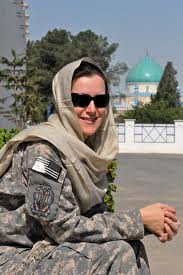
The U.S. military addresses cultural issues, even in how to dress**

Why does this profound institutional failure persist? I read it and hear versions of the premise that Afghans don’t live in the same globalized world as Americans all the time in defense contexts. The fact that it does persist should give us deep pause about how resources have been expended to create a more ‘culturally aware’ national security community. Continue reading

Posted in: Intercultural Communication, International Politics, Middle East, Narrative and Cognition, Narrative Research, National Security, Political Analysis, Politics and Policy, War and Violent Conflict Tags: , , , , , , , , ,

Lessons in Patriotism

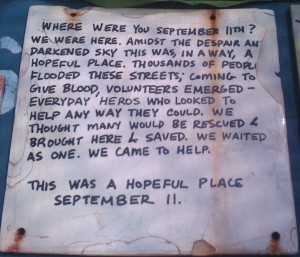
Tile made as part of a project that let people create their own commemorative tiles in 2001; they were later hung on a chain link fence in New York City's Greenwich Village (photo A. Zalman)

Patriotism—love of one’s country—is a treacherous emotion. Too little of it, and we aren’t motivated to make necessary sacrifices on behalf of our national brothers and sisters. Too much of it, or too much of the wrong sort, and exclusionary nationalism—in the form of various ethnic and religious hatreds- takes over. The challenges of getting patriotism right people think that we should avoid these dangers and keep emotion out of our public lives, substituting instead our critical faculties to reason our way to being fair and kind to each other.

But, as philosopher Martha Nussbaum argues, we require this form of love, “distinct from simple approval, or commitment or embrace of principles” in order to act on behalf of people we have never met—those people invoked by the idea of nation. Continue reading

Posted in: Intercultural Communication, National Security, Politics and Policy, War and Violent Conflict Tags: , , , , , , , , , ,

Communal Narrative on Parade at Annual West Indian American Day Carnival

In our social lives, narrative is not only something we tell but also something we perform. Public rituals like parades give us the chance to chronicle our communities in physical space and display the symbols and activities that define us. The words of George Fitch in Colliers Magazine in 1913, testifying to the popular pleasures of parades, are still true today.

The parade is an essential part of the American temperament. We not only inaugurate by parade, but we rejoice, mourn, commemorate, protest, inspire and argue by parades. Whenever two or three Americans are gathered together with a uniform within reach, they parade… The test of true brotherhood in any city is the willingness to parade in a white apron, a rooster feather hat, or a pair of baggy pink silk trousers.

Among the most joyous of these tests today is surely the annual West Indian American Day parade in Crown Heights, Brooklyn, an astonishing celebration of the colors, music and flavors of Carnival in the Caribbean, held this year on September 5, and an exuberant testament to multiculturalism. Continue reading

Posted in: Intercultural Communication, News and Journalism, Popular Culture Tags: , , ,

Narrative in Complex Decision Making: an Interview with Mary Crannell

Mary Crannell is one of those people whose broad intelligence and enthusiasm are hard to contain, as I learned when we met recently through a shared acquaintance. As the president of Idea Sciences, a decision-making support consultancy based in Alexandria, VA, Mary spends much of her time thinking about what technologies and processes will help her customers—such as the IMF, NATO, QinetiQ, the US Army, the UK Army, Verizon and Herman Miller, to name a few—arrive at good decisions. She is a frequent traveler to sites of conflict, as in a recent visit to Kabul, Afghanistan, where decision-making is an urgent, complex and ongoing task.

I was gratified when Mary agreed to share some of her thoughts on the role of narrative in decision-making generally, and in directing the American role in the world in productive directions, which is a concern many of her clients share.

Mary Crannell, President, Idea Sciences

AZ: How do you use narrative frameworks to help people make decisions?

MC: It is important to give people a way to define the vision of what they are trying to accomplish whether they are leading a state, a nation or an international organization. Is the system you are leading “on purpose?” We start with a vision. Continue reading

Posted in: Decision making, Information Systems, Intercultural Communication, International Politics, Middle East, Narrative Research, National Security, Public Diplomacy, Strategic Leadership, War and Violent Conflict Tags: , , , , , , , , , , ,

The Psychology of Conspiracy Theorists

Conspiracy Theories are Narratives on Steroids

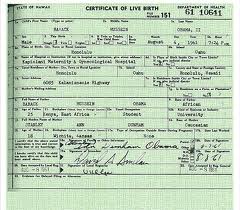
President Obama's Birth Certificate Doesn't Quell Conspiracy Theory that He Isn't an American Citizen

Conspiracy theories are narratives on steroids. In a story, the plot moves forward when one thing causes the next. In a conspiracy theory, cause is an outsized malignant force that knows everything and controls all events. Nothing happens randomly, all events are tied to the larger purpose of an always mysterious, always malefic agent. The amplification of current events into objects of global scrutiny also amplifies conspiracy theories, making them powerful agents in shifting public opinion. Thus with the so-called Birthers framing of President Obama as a foreigner, despite the overt presentation of facts proving that the president was born in the American state, Hawaii.

Conspiracy theorists stubbornly resist the facts at hand, finding reasons other than those given for why events unfold the way they do. Many Pakistanis appear to doubt that Osama bin Laden died as reported in mainstream news. According to a Gallup poll, “nearly half (49%) thought that the whole incident was actually staged for some reason or other. Only 26% thought the al-Qaeda chief was really killed on the night in question.” That’s a lot of people who think that the story circulated in mainstream media is crackpot, at best. And this week, 57% of respondents to a French poll believe that Dominique Strauss-Kahn is the victim of a conspiratorial plot by political rivals, rather than the victimizer of a hotel housemaid, as has been reported. Continue reading

Posted in: Books & Films, Conspiracy Theories, International Politics, Narrative Research, Politics and Policy, Popular Culture Tags: , , , , , , , ,

Strategic Narrative Definition

There is no concrete thing in the world-like a granny smith apple, or a suspension bridge-to which the term “strategic narrative” refers. Nevertheless, there are an increasing number of mentions of this abstraction out there, which means that a shared definition is beginning to form in the collective minds of different groups, so perhaps we are due for a strategic narrative definition.

Existing literature and commentary, as per a Google search of the term, produces two different-if overlapping-definitions “strategic narrative.”

Strategic Narrative in International Relations

For one community, “strategic” refers to the original meaning of the term to refer to military and political objectives. In ancient Greek, “strategos” is a compound term that means commander or leader of an army. “Strategic” materials are items needed to prosecute a war. Strategy is a subdiscipline of military science that focuses on planning war.

As a result, a “strategic narrative” can be understood as the story that a nation must tell itself, and the world, to wage a war or to maintain its competitive advantage in the international system. This is what the term means in the widely circulating document, “A National Strategic Narrative, written by two members of the American military. Anne Marie Slaughter, who introduces the document, defines a strategic narrative in terms of the competitive interests of a nation.

A narrative is a story. A national strategic narrative must be a story that all Americans can understand and identify with in their own lives. America’s national story has always see-sawed between exceptionalism and universalism. We think that we are an exceptional nation, but a core part of that exceptionalism is a commitment to universal values – to the equality of all human beings not just within the borders of the United States, but around the world. We should thus embrace the rise of other nations when that rise is powered by expanded prosperity, opportunity, and dignity for their peoples.

In one definition, then, “strategic narrative” refers to the use of “narrative” as an element of (national) strategy. This definition can be used in other organizations grounded in developing strategy.

In other professional disciplines, however, the concept of narrative, rather than strategy, grounds the definition.

Strategic Narrative in Public Relations

In public relations and related communications fields, the concept of a vehicle that conveys a message or idea is basic. “Message” is a traditional way of referring to a communication vehicle, but whereas a message can be conveyed in a bullet point, a narrative-a story-requires action, and drama and engaging characters. The idea of narratives as a way of communicating with consumers, or voters, or other constituencies has become popular. There is an entire sub-field now called “narrative marketing,” in which PR firms try to drive business growth through a “story-based perspective” A Canadian firm called Narrative Advocacy Media uses the premise to guide their entire marketing, branding and PR practice.

A strategic narrative, for communication practitioners, is an organizational narrative that has been planned to convey strategically meaningful elements about the organization’s identity and intentions. Some firms use the term narrative without really meaning “story” but rather simply to mean a descriptive text that uses words, instead of numbers.

The national security and business and PR understanding of “strategic narrative” overlap in important ways. All of these disciplines understand that the stories we tell and enact-through processes and actions-in our lives as social, political, creatures, can either be random and unthought, or they can be strategic and we can map them to goals we would like to achieve, and create them as spaces to be shared with the publics and audiences we’d like to reach.

Posted in: International Politics, Marketing & Branding, National Security, Public Relations Tags: , , , , ,

Body Scanners Expand the State’s Boundaries

bodd scanner

The recent flap over the TSA security measures –both manual pat-downs and backscatter x-ray and millimeter wave scanners—has been painted as presenting a conflict between personal privacy and national security.

We might more accurately call it a conflict over boundaries, personal and national. Who has the right to cross what borders? What is the proper boundary between my body and the state?

This trope, which is also present in other conflicts, like that over abortion, is particularly apt in a battle against terrorism. Boundaries, after all, are precisely what terrorists violate. Violent actors’ capacity to terrorize originates in their readiness to transgress both physical and moral boundaries. The more flagrant the violation, the more terrified we become. Terrorists do not obey the agreed on boundaries of sovereign states, nor those that we—the global community—have sanctioned to regulate war: we draw boundaries between just causes for war and unreasonable ones and, crucially, between combatants and civilians. The line between combatant and civilian in war is sacrosanct to most of us; on one side, we go toward injury, on the other, we are to be protected from it.

Perhaps it is the nature of this particular conflict that has led to a peculiar focus by the United States on bodies and boundaries, an intersection that is often shadowed by the erotic, whether for good or ill.

There is the ongoing confusion over whether others are combatants are civilians. We do not know where to draw the line. If you were an Afghan, or even a non-Afghan, in the orbit of Al Qaeda in 2001, did that make you a terrorist? Continue reading

Posted in: National Security, Politics and Policy, War and Violent Conflict Tags: , , , , ,