category archive: War and Violent Conflict

If You Want to Generate Strategies for Future Success, Start with Narratives and Metaphors

Terms like metaphor, myth, story and narrative are not necessarily the first that come to mind when considering how to develop a future-facing national strategy. But they should be. This point was made in brilliant ways by the participants at the Atlantic Council’s second annual Global Strategy Forum in Washington DC earlier this week.

Metaphors Shape how We Understand Reality

Our collective understanding of reality is shaped in profound ways by metaphors. A metaphor is a statement suggesting that something with which we are unfamiliar is like something with which we are familiar. New technologies often produce new metaphors for how we understand society writ large. The idea of the “networked organization,” for example, grows out of a comparison with computer networks. Being able to generate metaphors about the future can help strategists pave the way to creating the systems or processes that will be required for success in it.

I had the honor of sharing the opening session stage with DARPA Director Dr. Arathi Prabhakar and Rhodes College political scientist Jennifer Sciubba and our moderator Toffler Associates CEO Deborah Westphal to discuss Strategic Foresight.

Arathi talked about DARPA’s investments in artificial intelligence, Jennifer explored some of our myths about global demography, and I addressed our need for anticipatory metaphors (beginning at 44:21).

When Conditions Change, so Must Our Strategic Narratives

Despite our 3 different topics, we all stressed that changes in our global condition means that we must think in new ways about how to be successful. As the conditions of the industrial age fade away, so will our ability to define success in the terms of that era.

When global trends portend dramatic change, as ours do now, we must assess how we think about success, and rewrite the stories and myths that guide us in our quest to compete successfully. A hundred years ago, technological conditions privileged size—big tanks, and sizable armies could take territory and resources. Our guiding principle for success became: lets get big and control large spaces.

The rise of computer networks changed our social metaphors. We think in terms of networks now: social networks, networking, and everything from human bodies to neighborhoods as networks. We didn’t simply discover that all of these phenomena are arranged as networks, we applied a guiding metaphor to discover ways in which they are like networks.

My question is: what’s next? What will be the guiding metaphor of 25 years from now? The organization that can begin to frame an anticipatory metaphor-the future of our own imaginations- is preparing itself conceptually for the future. After that, structures, processes and systems will follow.

And while our conversation at the Atlantic Council was about the American role in the world, the basic takeaways for how to generate strong strategy apply to organizations everywhere.

To see the entire day’s sessions, go: here.


Posted in: Conferences, Decision making, Innovation, National Security, Strategic Communication, Strategic Leadership, War and Violent Conflict Tags: , , , , , , , , , , , , ,

Post-Boston: A More Effective Battle of Ideas (Part II)

Boston MarathonReprinted from The Globalist, April 24, 2013

Instead of getting sucked into heat-of-the-moment reactions to Boston, let’s base our responses on a more stable paradigm of contemporary global terrorism. To fight a battle of ideas successfully, one must first show what one is going up against. Amy Zalman makes the case that there are three distinct trends in terrorism — Hybrid, Multi-motivational and Narrative Terrorism.

This paradigm is evolving, but several trends are coming into view and are likely to deepen in the future:

  • Hybrid terrorism:

In traditional categorization of terrorists, there are “lone wolves” who are unconnected to any organized group and those who are members of organizations.

Today, a hybrid type appears to be evolving: someone who works without full organizational support or direction, but who is not working in total isolation from others. Continue reading

Posted in: Crisis Management, Intercultural Communication, International Politics, News and Journalism, Political Analysis, Politics and Policy, Strategic Leadership, War and Violent Conflict Tags: , , , , , , , , ,

Post-Boston: Keep Calm and Think Clearly (Part 1)

Boston Marathon

Reprinted from The Globalist, April 23, 2013

The Boston Marathon bombings provide an opportunity for the United States to consider how to combat extremist ideas more effectively than it did a decade ago. But this is not the time to let fear and uncertainty drive us into misguided and — as importantly — ineffective forms of countering violent extremism.

Warning: Prominent policy makers are already making demands to disinter the discredited concepts of the Global War on Terror. Options presented range from designating the bombers enemy combatants to calling for sweeping surveillance of majority Muslim communities.

The motivations that led Tamerlan and Dzhokar Tsarnaev to set off lethal bombs at the Boston Marathon last week may not yet be clear. But the characteristics of that event already tell us a substantial amount about the direction of 21st century terrorism — and how we might combat it with increasing effectiveness. Continue reading

Posted in: Crisis Management, Decision making, Intercultural Communication, International Politics, National Security, Political Analysis, Politics and Policy, War and Violent Conflict Tags: , , , , , , , ,

Narrative for Survival: My Grandmother’s Story

Stories can save lives. In One Thousand and One Nights, Sheherezade uses her storytelling talents to end King Shahrayr’s plot to punish his unfaithful wife by punishing all of the women of his kingdom. Having put to death the unfaithful Queen herself, the King embarks on a plan to marry a virgin of the Kingdom each night, and to have each killed at dawn. That is, until he marries Sheherezade, who spends her wedding night narrating to the King a most exciting and suspenseful tale. So exciting that the King puts off her death to hear how the story continues. And so their story continues for a thousand and one nights, after which the King abandons his goal to punish women, and marries Sheherezade.

My grandmother may not have had a thousand stories, but she had at least one, and telling it to an American Consul in 1939 saved her life and that of her husband and baby, when it permitted her to leave warring Europe on one of the last ships to cross the Atlantic. I had the opportunity to tell it at a local TedX event earlier this year, and was delighted when TEDx organizers chose it as one of their favorites. I’d love to hear about other stories that have saved lives, if you have one you’d like to share.

Posted in: Books & Films, Intercultural Communication, International Politics, Narrative forms, Politics and Policy, Popular Culture, War and Violent Conflict Tags: , , , , , , , , , ,

How Power Works in the 21st Century

We live in stories. That is, we are always in the process of trying to make sense of what is happening to us and around us. That process drives us – to vote, to go into the street and fight for a nation, to make changes in how we consume, or to do none of the above.

Political leadership that understands that stories, perceptions, values, ideas, culture are present wherever there is human activity have a powerful tool for understanding what drives both change and apathy.

There is no name more firmly associated with linking political power and values and ideas than that of Joseph Nye. He coined the term soft power, which is power that stems from the intangible sources such as “institutions, ideas, values, culture …” as he explains in The Future of Power.

Earlier this week, The Globalist published my article, How Power Really Works in the 21st Century: Beyond Soft, Hard and Smart. In it, I explain how, in a networked, information driven age, the power of symbols and ideas is always an important part of the strategic landscape. Nye’s insight that culture, ideas, perceptions, stories has been deeply assimilated into strategic thinking—a great tribute to him. But the insight has outgrown the categories that once described them. Continue reading

Posted in: Crisis Management, Decision making, International Politics, National Security, Political Analysis, Politics and Policy, Public Diplomacy, Strategic Leadership, War and Violent Conflict Tags: , , , , , , , , ,

The Definition of Strategic Narrative: an Evolving Concept in International Affairs

In an earlier post, I outlined ways in which the term strategic narrative is used in current practice, in public relations—as an element of marketing—and in the academic field of international relations. This post returns to the evolution of the term as an applied concept in foreign affairs.

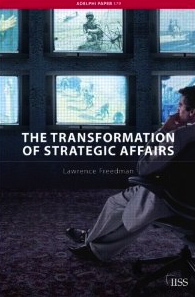
According to International Relations professor Alister Miskimmon (who I asked by email), the first published use of the term “strategic narrative” was by Lawrence Freedman, a professor of War Studies at King’s College, London. In 2006, Freedman wrote a paper called The Transformation of Strategic Affairs. Many of the insights in Freedman’s work stem from the Western experience of war in the post-9/11 years, and the discovery—the hard way, through experience—that the era of large scale land warfare may be decisively over. In its place, the future promises smaller wars, waged by insurgents as well as governments, in which human factors such as behavior, culture and communication play meaningful roles.

In this context, Freedman identifies “strategic narratives” as a kind of secret weapon of networked combatants fighting irregular wars. In Freedman’s view, a story that connects people emotionally to an identity and a mission “helps dispersed groups to cohere and guides its strategy. Individuals know the sort of action expected of them and the message to be conveyed.”

Thus, in Freedman’s definition, narrative is a function of strategy in the most traditional sense related to the science of war. In that vein, he argues that: Continue reading

Posted in: International Politics, Middle East, Narrative Research, National Security, Politics and Policy, War and Violent Conflict Tags: , , , , , , , , , , , ,

Behavioral Economics Go to War

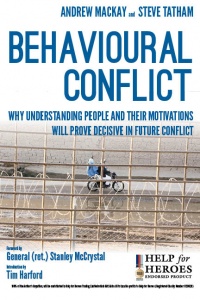
Review of Behavioural Conflict, Why Understanding People and their Motivations Will Prove Decisive in Future Conflict, by Andrew Mackey and Steve Tatham

I cannot think of any books about warfare’s future that come across as hard-hitting, full of actionable pragmatism, and deeply humane all at the same time. But Behavioral Conflict: Why Understanding People and their Motivations will Prove Decisive in Future Conflict is all three. The authors, both career members of the British military, Major General Andres Mackey (Ret) and Royal Navy Commander Steve Tatham (who I count as a friend, having met him in Ankara a few years ago), make their case by drawing on a combination of their own experience, case studies and close analysis of how communication actually factors in war.

Hard-hitting and pragmatic: Mackey and Tatham are precise and lucid about what they mean by “behavior” and how to make use of it to gain advantage in conflict. They, and behavioral psychologist Lee Rowland, who adds a chapter on the science of influence, are not putting forth any of the following: A call for greater “cultural awareness,” a mushy program about how to change others’ attitudes, or a repeat of the last decade’s focus on consumer marketing as the key to public diplomacy. They offer instead this thesis based on a simple chain of claims:

  • The world of human motivation and perception is inevitably complex.
  • It is more important to try to shape behavior than it is to change people’s attitudes.
  • Behavior shaping begins with a discrete grasp of the circumstances under which people already behave in ways that are desirable, and extends to efforts to replicate those or similar circumstances. Continue reading

Posted in: Books & Films, Decision making, Intercultural Communication, International Politics, Narrative Research, National Security, Politics and Policy, Strategic Leadership, War and Violent Conflict Tags: , , , , , , , , , , , , , , ,

Announcement: U.S. State Department Strategic Narratives Public Meeting

At the RAND Corporation in Santa Monica, CA, November 29

From the State Department Announcement:

The U.S. Advisory Commission on Public Diplomacy will hold a public meeting on the topic of strategic narratives November 29, 2011, in Santa Monica, CA, in partnership with the RAND Corporation. The meeting will take place at the RAND offices at 1776 Main Street in Santa Monica, CA, in the Forum Auditorium. It will begin at 9:00 am and end at 3:00 p.m. with doors open for registration and continental breakfast at 8:30 a.m. The event will be webcast live and will emphasize open-forum question and response periods with the audience.

To attend, contact the RAND Corporation no later than November 21 by phone at (412)683-2300 ext 4906 or email to [email protected] and provide your full name, citizenship (U.S. citizenship is not required to attend), and institutional/organizational affiliation. Continue reading

Posted in: Conferences, Narrative Research, National Security, Politics and Policy, Public Diplomacy, War and Violent Conflict Tags: , , , , , , , , ,

Afghanistan Narrative, Still Wrong, but Reparable

Earlier this month, Benjamin Hopkins and Magnus Marsden, authors of the forthcoming Fragments of the Afghan Frontier, argued strenuously in a New York Times Op Ed that the U.S. strategy in Afghanistan is as culturally inept as it was when we went to war a decade ago. The American obsession with viewing Afghanistan though the lens of tribal tradition is borrowed from 19th century Brits, whose understanding tribal mores was in large part composed of fanciful inventions of their own. Above all:

Afghanistan is not a country of primitive tribes cut off from the modern world. The singular focus on tribes, the Taliban, and ethnicity as the keys to understanding and resolving the conflict misses the nuances of the region’s past and present. Rather than fanatical tribesmen or poor victims in need of aid, many of these people are active and capable participants in a globalized economy.

http://navylive.dodlive.mil/index.php/2010/10/19/issues-of-the-veil/#disqus_thread

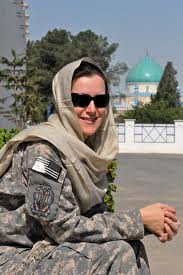
The U.S. military addresses cultural issues, even in how to dress**

Why does this profound institutional failure persist? I read it and hear versions of the premise that Afghans don’t live in the same globalized world as Americans all the time in defense contexts. The fact that it does persist should give us deep pause about how resources have been expended to create a more ‘culturally aware’ national security community. Continue reading

Posted in: Intercultural Communication, International Politics, Middle East, Narrative and Cognition, Narrative Research, National Security, Political Analysis, Politics and Policy, War and Violent Conflict Tags: , , , , , , , , ,

Lessons in Patriotism

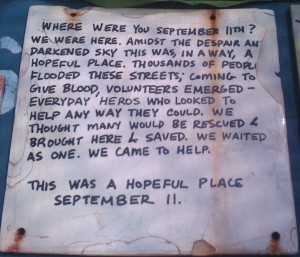
Tile made as part of a project that let people create their own commemorative tiles in 2001; they were later hung on a chain link fence in New York City's Greenwich Village (photo A. Zalman)

Patriotism—love of one’s country—is a treacherous emotion. Too little of it, and we aren’t motivated to make necessary sacrifices on behalf of our national brothers and sisters. Too much of it, or too much of the wrong sort, and exclusionary nationalism—in the form of various ethnic and religious hatreds- takes over. The challenges of getting patriotism right people think that we should avoid these dangers and keep emotion out of our public lives, substituting instead our critical faculties to reason our way to being fair and kind to each other.

But, as philosopher Martha Nussbaum argues, we require this form of love, “distinct from simple approval, or commitment or embrace of principles” in order to act on behalf of people we have never met—those people invoked by the idea of nation. Continue reading

Posted in: Intercultural Communication, National Security, Politics and Policy, War and Violent Conflict Tags: , , , , , , , , , ,