category archive: Popular Culture

7 Necessary Narratives for the New Digital Age

In the future, nearly everyone will be connected to the Internet and to each other, claim Jared Cohen and Eric Schmidt in The New Digital Age.

Mass connectivity will transform our relationships, our governments, our work, our bodies and the objects around us. But even these dramatic transformations will not change the fact that we are corporeal creatures, and that we will still live lives grounded in phnew digital agephysical circumstances, whether those are urban or rural, rich or poor, lucky or unlucky.
We will also come into the world with a set of inherited stories about who we are, what our lives mean, and what the future looks like. These stories will have the same universal threads they always have: we will still have stories of love, stories of family, stories that try reconcile life’s fundamental unfairness. But they will also fail in important ways to explain the transformations of our lives, and the new ways in which we will do old things.

We need new stories

We need new stories. Creating them is of necessity not only a collective task, but a transnational one. As we grow even more connected, we also grow more capable of exporting our ideas about who we are and what is important on others, wherever they are. Yesterday, two Nigeria-descended men hacked a third to death on a London street, and then stayed on the scene to tell how they saw themselves in a world at war: “We must fight them as they fight us.” As we grow more connected, and more willing to share our selves with others, maybe pernicious forms of shame—that universal emotion—will be knocked out, and we’ll be more healthy.

It all depends on how we decide to tell our future. Here are seven of the areas where we will need new stories in the new digital age, as described by Schmidt and Cohen.


7 Necessary Narratives for the New Digital Age

1. The Body

Both religion and science fiction have long dreamed of worlds in which humans transcend bodies, to become virtual souls. In the new digital world, however, we will shape our identities online but experience them in the physical world. How will we understand health and illness, and mortality, if we have the capacity to monitor our daily rhythms in minute ways?

2. Personal Identity

Schmidt and Cohen tell us that identity will be each of our most valuable commodity in the future, and that our true personal identity will be the one that we shape online.

How will we choose to tell our life stories and in what ways will the autobiographical form change in a world in which there is essentially no privacy? Where will we think our “real” self resides. Where will the associations with privacy as a space of intimacy, daydreaming, erasable exploration, unrecorded experimentation with who we are, in order to practice who we could be, relocate, when we have no privacy?

3. News

Our concepts of journalism and news reporting have already undergone dramatic changes; journalism has become in many ways a collective task that falls to professional reporters and citizens alike, and to groups and organizations that put out versions of the news that support particular causes or points of view.

As an increasing number of voices join in the journalistic task, the work of professional media will evolve. The media might become a trusted validator of unsubstantiated accounts, or an integrator of news from different kinds of sources. The value of objectivity may fade, while versions of what subjective news that maintains its integrity will emerge—this will be the new narrative of news.

4. Cybersecurity

Different forms of public security – whether they are in the arena of health, or counterterrorism, or child safety – operate according to different metaphors, storylines and images. Those around cyber-security may coalesce around metaphors of health and hygiene: we are told to practice “cyber-hygiene.

Schmidt and Cohen introduce Microsoft Chief Research and Strategy Officer, who has also recommended a “World Health Organization” for cyber-activity, and the practice of quarantining computers that have been infected with viruses. As Adriane Lapointe, a National Security Agency official has observed, the public health metaphor may serve as the basis for a meaningful public narrative:

Like any good metaphor, it invites us to consider illuminating similarities between two overtly dissimilar things—malware on the internet and infectious disease in a community—similarities that can lead us to reframe a familiar topic. It also identifies a policy precedent, reminding us that we do, as a society, recognize the need to impose some restrictions on individuals who involuntarily pose a certain kind of threat to others, and that we have a mechanism to do this which might be relevant to cybersecurity matters. Whether we ultimately decide that this mechanism or approach is appropriate to the cyber challenge, the metaphor has certainly helped to broaden thinking about the subject.

5. National Identity

The nation-state has been the bedrock of our civic identities for the last couple of centuries, and the idea that every nation deserves its own territorial state a driving narrative of the 20th century. But new diasporas resulting from increased migration, coupled with digital connectivity, are decoupling the nation from the state, creating virtual, de-territorialized nations.

How will a de-territorialized nation narrate its future? How will cultural practices that have been grounded in place be translated into practices of other place? Will other forms of bonding, such as investment in the home country, become a standard part of an individual’s narrative of their national identity? Will the idea of a relationship to a particular land wither for some communities, and if so, to what effect?

6. Dissident Leadership

There is much to protest in this world, and the low cost of entry to share dissident views will lead to a widening number of protestors seeking attention for their cause. Many of these causes will be worthy and compelling, so it is no longer enough to offer the platitude the most persuasive stories will gain our attention. Rather, we—the public that dissidents must win over-may begin to change the meta-story, or standards, by which we evaluate leaders and causes.

Schmidt and Cohen offer that dissident leaders likely to become popular will be able to: “command a following and crowd-source their online support,” will know how to exploit digital marketing tools, and will show their commitment by putting themselves at physical risk.

We can already guess that digital marketing skills are not the most important skills for someone seeking a leadership role in a dissident setting. We can use this recognition starting now to inoculate ourselves against easily accepting simply the most digitally skilled. We can ask, instead, what are the qualities—what is the story—of a leader who is likely to be successful, who understands the institutions they want to change, and lead that change on the ground as well as in virtual space.

7. Justice

Cameras in our smallest devices make it easy to record the human capacity for barbarism in its many forms. Violence, sexual assault, cruelty to animals, hate speech all find their way into digital form on a regular basis, easily arousing our instinctual repugnance. As Schmidt and Cohen observe, these recordings can become the basis for “crowd sourced justice,” which may take the form of mob retaliation, from harassment to violence.

But we could instead form new habits of collective responsibility—using our connectivity to make sure that those who commit bad acts are dealt with according to our legal precepts and best values, and to explore together how to deal with bad behavior at the community level. Which narrative, and which set of practices that prevail, depend on how we decide to narrate our opportunity to ‘crowd source justice,’ which behaviors we highlight and celebrate, and how we talk about what we see online.

Posted in: Books & Films, Intercultural Communication, International Politics, Marketing & Branding, Popular Culture, Public Relations Tags: , , , , , , ,

Narrative for Survival: My Grandmother’s Story

Stories can save lives. In One Thousand and One Nights, Sheherezade uses her storytelling talents to end King Shahrayr’s plot to punish his unfaithful wife by punishing all of the women of his kingdom. Having put to death the unfaithful Queen herself, the King embarks on a plan to marry a virgin of the Kingdom each night, and to have each killed at dawn. That is, until he marries Sheherezade, who spends her wedding night narrating to the King a most exciting and suspenseful tale. So exciting that the King puts off her death to hear how the story continues. And so their story continues for a thousand and one nights, after which the King abandons his goal to punish women, and marries Sheherezade.

My grandmother may not have had a thousand stories, but she had at least one, and telling it to an American Consul in 1939 saved her life and that of her husband and baby, when it permitted her to leave warring Europe on one of the last ships to cross the Atlantic. I had the opportunity to tell it at a local TedX event earlier this year, and was delighted when TEDx organizers chose it as one of their favorites. I’d love to hear about other stories that have saved lives, if you have one you’d like to share.

Posted in: Books & Films, Intercultural Communication, International Politics, Narrative forms, Politics and Policy, Popular Culture, War and Violent Conflict Tags: , , , , , , , , , ,

Intertextuality for Strategic Communication

The Power of Reference, Allusion and Quotation in Communication

Two recent films, Skyfall and Anna Karenina, are made more intensely meaningful by their intentional intertextuality-their incorporation of previous iterations and interpretations of the story they are themselves telling. Both offer insights into the ways communicators can benefit from the same kind of internal referentiality.

The Concept of Intertextuality

Literary and linguistic theorists began to work with the concept of intertextuality in the mid-1960s, when theorist Julia Kristeva coined the term. Scholarly definitions have proliferated and grown increasingly technical in the intervening half century. For our purposes, the following definition works just fine: Intertextuality means that texts – novels, paintings, films, but also tax codes and thank you letters –gain meaning not through their reference to an external reality, but by their reference to pre-existing other texts. Intertextuality is not a choice, but rather an inevitable by- product of creating, because we are always creating into already existing histories, discourses and ways of interpreting. These existing frames have already partly shaped what we will produce and how it will be recieved. An author or an artist may intend to give us something original, but they can’t, fully. We readers, in turn, never have direct access to a work, but can only get at it by making our way through its prior iterations and interpretations.

James Bond and Anna Karenina are among the most iconic popular texts in modern Western culture. The James Bond series, which is the longest-running film series in history, has given us the rules by which we define spy thrillers. Anna Karenina is no longer only the Leo Tolstoy novel, but also the dozens of derivative films, ballets, operas and musicals that have been created since the late 19th century.

Both are completely enmeshed in our everyday language — we think things about ourselves through the mesh of their expressions:“Bond, James Bond,” and “Shaken, not stirred,”are shorthand invocations of suave masculinity. “All happy families are alike, but each unhappy family is unhappy in its own way,” has become a catch-all syntax for describing the singularity of just about anything, including in statistics, where the “Anna Karenina principle” is applied to ecological and economic puzzles.

Semiotics professor Daniel Chandler explains the implications of intertextuality: Continue reading

Posted in: Books & Films, Intercultural Communication, Marketing & Branding, Narrative forms, Popular Culture, Public Relations, Strategic Communication Tags: , , , , , , ,

Hacker Narrative: Next Chapter in History of Civil Rights?

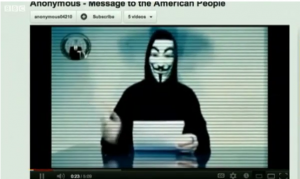
Peter Fein, self described Hacktivist, recently revealed he is a member of the group Anonymous, a self-organized group that targets institutions that stand in the way of their vision of Internet freedom with Distributed Denial of Service(DDOS) attacks. DDOS attacks are a way of effectively shutting down websites by overwhelming them with traffic.

The hacktivist group Anonymous: the next chapter in the story of American civil liberties?

For much of the U.S. security and legal community, hacktivists are criminals and security threats. In another popular image, hacktivists are anarchists dedicated to total liberty.

Peter Fein doesn’t see it either way, for him, his activities place him at the center of a uniquely American history of ever progressing civil rights. Continue reading

Posted in: Information Systems, International Politics, Legal Issues, National Security, Politics and Policy, Popular Culture Tags: , , , , , ,

The Form of National Myths

Storytelling pole of the Haida nation

I was reminded of the tremendous elasticity of narrative forms when I recently visited the Denver Art Museum’s amazing American Indian art collection for the first time, by the Haida storytelling pole near the entrance of the collection. The Haida is a native tribe of the Northwest coast of the United States and Canada and, like other tribes of the coast, are known for the immense carved poles through which tribal myths are told.

The story told in this pole is about a man who was almost captured by otters when his canoe capsized. The figures at the very top of the pole are watchmen. Next lowest is the man who escaped the otters, holding an otter by the tail. The figure in the middle represents the cave where the otters live and at the very bottom is a cave spirit, who holds a stingray.

My own inclination was to try to “read” the pole in a linear direction, from top to bottom, to find in it the action part of the story, in which the man escapes the otters. But the real story may lie less in the pole itself than in the interaction between community members and the symbolic item, Continue reading

Posted in: Narrative Research, Popular Culture Tags: , , ,

2011: Year of the Protest Narrative

E.M. Forster famously distinguished events that are yoked only by their temporal order from those that we would consider a narrative (which he called “plot”), in which events are causally linked, with this pithy comparison:

1. The King died and then the Queen died (2 events tied only by temporal order)

2. The King died and then the Queen died of grief (the second event is caused by the first)

I’ve had this distinction on my mind as year-end wrap-ups circulate in the media.

photographer: David Shankbone

Protestors on Wall Street, September 30, 2011

The global scope of economic crisis and dramatic protests give commentators a lot of latitude to tell the story of this year in a variety of ways. Did Mohamed Bouazizi’s galvanizing protest by fire, and the subsequent fall of the Tunisian government cause Egyptian protests? And did these, in some way cause Occupy Wall Street? Do the protests in Chile, Tel Aviv and Russia have anything to do with each other, or with others? Continue reading

Posted in: Intercultural Communication, International Politics, Middle East, Politics and Policy, Popular Culture Tags: , , , ,

Communal Narrative on Parade at Annual West Indian American Day Carnival

In our social lives, narrative is not only something we tell but also something we perform. Public rituals like parades give us the chance to chronicle our communities in physical space and display the symbols and activities that define us. The words of George Fitch in Colliers Magazine in 1913, testifying to the popular pleasures of parades, are still true today.

The parade is an essential part of the American temperament. We not only inaugurate by parade, but we rejoice, mourn, commemorate, protest, inspire and argue by parades. Whenever two or three Americans are gathered together with a uniform within reach, they parade… The test of true brotherhood in any city is the willingness to parade in a white apron, a rooster feather hat, or a pair of baggy pink silk trousers.

Among the most joyous of these tests today is surely the annual West Indian American Day parade in Crown Heights, Brooklyn, an astonishing celebration of the colors, music and flavors of Carnival in the Caribbean, held this year on September 5, and an exuberant testament to multiculturalism. Continue reading

Posted in: Intercultural Communication, News and Journalism, Popular Culture Tags: , , ,

The Psychology of Conspiracy Theorists

Conspiracy Theories are Narratives on Steroids

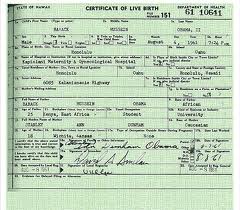
President Obama's Birth Certificate Doesn't Quell Conspiracy Theory that He Isn't an American Citizen

Conspiracy theories are narratives on steroids. In a story, the plot moves forward when one thing causes the next. In a conspiracy theory, cause is an outsized malignant force that knows everything and controls all events. Nothing happens randomly, all events are tied to the larger purpose of an always mysterious, always malefic agent. The amplification of current events into objects of global scrutiny also amplifies conspiracy theories, making them powerful agents in shifting public opinion. Thus with the so-called Birthers framing of President Obama as a foreigner, despite the overt presentation of facts proving that the president was born in the American state, Hawaii.

Conspiracy theorists stubbornly resist the facts at hand, finding reasons other than those given for why events unfold the way they do. Many Pakistanis appear to doubt that Osama bin Laden died as reported in mainstream news. According to a Gallup poll, “nearly half (49%) thought that the whole incident was actually staged for some reason or other. Only 26% thought the al-Qaeda chief was really killed on the night in question.” That’s a lot of people who think that the story circulated in mainstream media is crackpot, at best. And this week, 57% of respondents to a French poll believe that Dominique Strauss-Kahn is the victim of a conspiratorial plot by political rivals, rather than the victimizer of a hotel housemaid, as has been reported. Continue reading

Posted in: Books & Films, Conspiracy Theories, International Politics, Narrative Research, Politics and Policy, Popular Culture Tags: , , , , , , , ,

Transmedia Storytelling Goes Beyond Entertainment

Transmedia Storytelling, according to media psychologist Pamela Rutledge in Psychology Today is “the new standard for 21st century communication:”

Transmedia storytelling uses multiple media platforms to tell a single, coherent story or narrative that unfolds across time. Each media piece-whether it’s a website, novel, video games, mobile apps, or a film-provides different points of access and can engage different demographics. Each media components add to the story while functioning as a standalone experience. Each component invites some level of participation. The story can be experienced and appreciated at any stage, but the cumulative effect of all the pieces makes a larger, richer and more engaging message experience.

Until recently, transmedia storytelling has been primarily a term-of-art for the entertainment business. The concept is making its way beyond entertainment into the world of business and organizational strategy. Rutledge explains it as a branding and marketing function, but also holds out executive development benefits. In a transmedia context, the message cannot precede the media. Instead of telling the same story in the same way in different spaces, executives will begin with an understanding of the simultaneously fragmented and interlocking qualities of our communications space, and seek to help us experience their story across time and in different spaces. In the midst of this basic process, they will learn their own story-and its gaps and inconsistencies-much better, according to Rutledge.

The potential applications of this framework in other contexts readily suggest themselves. Political campaigns, development projects, education, and business, could all make use of the formula that transmedia storytelling proposes, in which different pieces of a coherent story are told through different media, in different ways, at various times.

New ways of exploiting this framework are sure to arise, as the list of commentators elaborating, and stretching the concept to new limits, suggests:

  • Transmedia Storytelling 101, by Henry Jenkins
  • Georgy Cohen on transmedia storytelling as part of higher education branding
  • Transmedia Storytelling, What is It? by John Ryan


Posted in: Marketing & Branding, Popular Culture Tags: , ,

“Adjustment Bureau” Adjusts Individual Lives to Fit Institutional Narratives

The Adjustment BureauThe Adjustment Bureau is a film about narratives, and about who has the power to tell them. Based loosely on the 1954 Philip K. Dick short story, “Adjustment Team,” it tells of the story of the effort by one man (played by Matt Damon) to wrest control over his own life from larger forces. Meanwhile, those forces, in the institution of the “Adjustment Bureau,” maintain that control of human destiny lies in their hands.

“You only have the appearance of free will,” Damon is instructed by one of the elders in the Bureau, an organization that appears to be a cross between a Ford factory and Heaven. The Adjustment Bureau wants Damon, a New York senator, to be president and change the course of world events. They fear that if Damon follows his own heart, and his love for a ballerina, he will lose his ambition.

The film offers much food for thought at a moment when personal struggles to maintain personal control over individual destinies, despite the larger forces of nature and politics, are playing out dramatically on virtually every continent. In Japan, in Libya, in the American Midwest, in Australia, where floods devastated the Queensland coast this winter.

One can’t help but wonder whether the redemptive possibilities that Dick’s vision offers is a fantasy or a model we can take to heart. It also asks us to consider how much agency the institutions that drive our lives possess: our governments, banks, universities, and companies. In The Adjustment Bureau, the institution is deeply interested in the course of individuals’ actions, but only to the extent that they align with the larger intentions of the organization.

Either way, the dramatic conflict between the determinism of the faceless institutions in which we live and the protagonists, who battle that determinism, rings true. And recognizing the inherent tension between individuals and institutions, instead of pasting them over, is a useful step in teasing out the real story of how we realize our ambitions.

Posted in: Books & Films, Popular Culture Tags: , ,