category archive: International Politics

7 Necessary Narratives for the New Digital Age

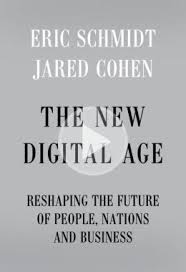
In the future, nearly everyone will be connected to the Internet and to each other, claim Jared Cohen and Eric Schmidt in The New Digital Age.

Mass connectivity will transform our relationships, our governments, our work, our bodies and the objects around us. But even these dramatic transformations will not change the fact that we are corporeal creatures, and that we will still live lives grounded in phnew digital agephysical circumstances, whether those are urban or rural, rich or poor, lucky or unlucky.
We will also come into the world with a set of inherited stories about who we are, what our lives mean, and what the future looks like. These stories will have the same universal threads they always have: we will still have stories of love, stories of family, stories that try reconcile life’s fundamental unfairness. But they will also fail in important ways to explain the transformations of our lives, and the new ways in which we will do old things.

We need new stories

We need new stories. Creating them is of necessity not only a collective task, but a transnational one. As we grow even more connected, we also grow more capable of exporting our ideas about who we are and what is important on others, wherever they are. Yesterday, two Nigeria-descended men hacked a third to death on a London street, and then stayed on the scene to tell how they saw themselves in a world at war: “We must fight them as they fight us.” As we grow more connected, and more willing to share our selves with others, maybe pernicious forms of shame—that universal emotion—will be knocked out, and we’ll be more healthy.

It all depends on how we decide to tell our future. Here are seven of the areas where we will need new stories in the new digital age, as described by Schmidt and Cohen.


7 Necessary Narratives for the New Digital Age

1. The Body

Both religion and science fiction have long dreamed of worlds in which humans transcend bodies, to become virtual souls. In the new digital world, however, we will shape our identities online but experience them in the physical world. How will we understand health and illness, and mortality, if we have the capacity to monitor our daily rhythms in minute ways?

2. Personal Identity

Schmidt and Cohen tell us that identity will be each of our most valuable commodity in the future, and that our true personal identity will be the one that we shape online.

How will we choose to tell our life stories and in what ways will the autobiographical form change in a world in which there is essentially no privacy? Where will we think our “real” self resides. Where will the associations with privacy as a space of intimacy, daydreaming, erasable exploration, unrecorded experimentation with who we are, in order to practice who we could be, relocate, when we have no privacy?

3. News

Our concepts of journalism and news reporting have already undergone dramatic changes; journalism has become in many ways a collective task that falls to professional reporters and citizens alike, and to groups and organizations that put out versions of the news that support particular causes or points of view.

As an increasing number of voices join in the journalistic task, the work of professional media will evolve. The media might become a trusted validator of unsubstantiated accounts, or an integrator of news from different kinds of sources. The value of objectivity may fade, while versions of what subjective news that maintains its integrity will emerge—this will be the new narrative of news.

4. Cybersecurity

Different forms of public security – whether they are in the arena of health, or counterterrorism, or child safety – operate according to different metaphors, storylines and images. Those around cyber-security may coalesce around metaphors of health and hygiene: we are told to practice “cyber-hygiene.

Schmidt and Cohen introduce Microsoft Chief Research and Strategy Officer, who has also recommended a “World Health Organization” for cyber-activity, and the practice of quarantining computers that have been infected with viruses. As Adriane Lapointe, a National Security Agency official has observed, the public health metaphor may serve as the basis for a meaningful public narrative:

Like any good metaphor, it invites us to consider illuminating similarities between two overtly dissimilar things—malware on the internet and infectious disease in a community—similarities that can lead us to reframe a familiar topic. It also identifies a policy precedent, reminding us that we do, as a society, recognize the need to impose some restrictions on individuals who involuntarily pose a certain kind of threat to others, and that we have a mechanism to do this which might be relevant to cybersecurity matters. Whether we ultimately decide that this mechanism or approach is appropriate to the cyber challenge, the metaphor has certainly helped to broaden thinking about the subject.

5. National Identity

The nation-state has been the bedrock of our civic identities for the last couple of centuries, and the idea that every nation deserves its own territorial state a driving narrative of the 20th century. But new diasporas resulting from increased migration, coupled with digital connectivity, are decoupling the nation from the state, creating virtual, de-territorialized nations.

How will a de-territorialized nation narrate its future? How will cultural practices that have been grounded in place be translated into practices of other place? Will other forms of bonding, such as investment in the home country, become a standard part of an individual’s narrative of their national identity? Will the idea of a relationship to a particular land wither for some communities, and if so, to what effect?

6. Dissident Leadership

There is much to protest in this world, and the low cost of entry to share dissident views will lead to a widening number of protestors seeking attention for their cause. Many of these causes will be worthy and compelling, so it is no longer enough to offer the platitude the most persuasive stories will gain our attention. Rather, we—the public that dissidents must win over-may begin to change the meta-story, or standards, by which we evaluate leaders and causes.

Schmidt and Cohen offer that dissident leaders likely to become popular will be able to: “command a following and crowd-source their online support,” will know how to exploit digital marketing tools, and will show their commitment by putting themselves at physical risk.

We can already guess that digital marketing skills are not the most important skills for someone seeking a leadership role in a dissident setting. We can use this recognition starting now to inoculate ourselves against easily accepting simply the most digitally skilled. We can ask, instead, what are the qualities—what is the story—of a leader who is likely to be successful, who understands the institutions they want to change, and lead that change on the ground as well as in virtual space.

7. Justice

Cameras in our smallest devices make it easy to record the human capacity for barbarism in its many forms. Violence, sexual assault, cruelty to animals, hate speech all find their way into digital form on a regular basis, easily arousing our instinctual repugnance. As Schmidt and Cohen observe, these recordings can become the basis for “crowd sourced justice,” which may take the form of mob retaliation, from harassment to violence.

But we could instead form new habits of collective responsibility—using our connectivity to make sure that those who commit bad acts are dealt with according to our legal precepts and best values, and to explore together how to deal with bad behavior at the community level. Which narrative, and which set of practices that prevail, depend on how we decide to narrate our opportunity to ‘crowd source justice,’ which behaviors we highlight and celebrate, and how we talk about what we see online.

Posted in: Books & Films, Intercultural Communication, International Politics, Marketing & Branding, Popular Culture, Public Relations Tags: , , , , , , ,

Let’s Celebrate the 2nd Anniversary of “A National Strategic Narrative”

This has been a tough spring for national cohesion in the United States. Automatic federal spending cuts called sequestration kicked in after Congress failed to agree on how to manage the federal budget. The Senate voted down a bill that would expand background checks for gun purchasers, despite strong support around the country. And bombings at the Boston Marathon committed by young men hovering between foreign identity and American citizenship confused any clear idea of American identity.

This makes it a good time to mark the two year anniversary of A National Strategic Narrative, published in April 2011 by aNational Strategic Narrativeuthors Captain Wayne Porter, USN and Col Mark Mykleby, USMC under the pseudonym Mr. Y.

The document grabbed the attention of politicians and pundits here in the United States, and foreign ministers in Europe and the Middle East. Perhaps most important, it garnered attention from everyday citizens for proposing a reinvigorated American identity and role in the world. Continue reading

Posted in: Books & Films, Decision making, Intercultural Communication, International Politics, National Security, Politics and Policy, Strategic Communication, Strategic Leadership Tags: , , , , , , , , , , ,

Post-Boston: A More Effective Battle of Ideas (Part II)

Boston MarathonReprinted from The Globalist, April 24, 2013

Instead of getting sucked into heat-of-the-moment reactions to Boston, let’s base our responses on a more stable paradigm of contemporary global terrorism. To fight a battle of ideas successfully, one must first show what one is going up against. Amy Zalman makes the case that there are three distinct trends in terrorism — Hybrid, Multi-motivational and Narrative Terrorism.

This paradigm is evolving, but several trends are coming into view and are likely to deepen in the future:

  • Hybrid terrorism:

In traditional categorization of terrorists, there are “lone wolves” who are unconnected to any organized group and those who are members of organizations.

Today, a hybrid type appears to be evolving: someone who works without full organizational support or direction, but who is not working in total isolation from others. Continue reading

Posted in: Crisis Management, Intercultural Communication, International Politics, News and Journalism, Political Analysis, Politics and Policy, Strategic Leadership, War and Violent Conflict Tags: , , , , , , , , ,

Post-Boston: Keep Calm and Think Clearly (Part 1)

Boston Marathon

Reprinted from The Globalist, April 23, 2013

The Boston Marathon bombings provide an opportunity for the United States to consider how to combat extremist ideas more effectively than it did a decade ago. But this is not the time to let fear and uncertainty drive us into misguided and — as importantly — ineffective forms of countering violent extremism.

Warning: Prominent policy makers are already making demands to disinter the discredited concepts of the Global War on Terror. Options presented range from designating the bombers enemy combatants to calling for sweeping surveillance of majority Muslim communities.

The motivations that led Tamerlan and Dzhokar Tsarnaev to set off lethal bombs at the Boston Marathon last week may not yet be clear. But the characteristics of that event already tell us a substantial amount about the direction of 21st century terrorism — and how we might combat it with increasing effectiveness. Continue reading

Posted in: Crisis Management, Decision making, Intercultural Communication, International Politics, National Security, Political Analysis, Politics and Policy, War and Violent Conflict Tags: , , , , , , , ,

Resilience Narratives Key to Resilient Systems

The 2013 World Economic Forum Conference that began today in Davos is dedicated this year to resilient dynamism. As Arianna Huffington noted earlier in the day, the key concept that gives rise to the need for resilience is our global interconnectedness. Quoting Rockefeller Foundation President Judith Rodin, she cites five attributes that resilient systems characteristically share:

  • Spare capacity
  • Flexibility — the ability to change, evolve, and adapt in the face of disaster.
  • Limited or “safe” failure, which prevents failures from rippling across systems.
  • Rapid rebound — the capacity to reestablish function and avoid long-term disruptions.
  • Constant learning, with robust feedback loops.

Huffington adds a sixth, “the will to want to be resilient.”

To that list, I feel we must add a seventh requirement for the present and future, Resilience Narratives: stories that will help disparate and potentially adversarial players see themselves as active participants in collaborative futures. Continue reading

Posted in: Conferences, Crisis Management, Decision making, Intercultural Communication, International Politics, Politics and Policy, Strategic Communication, Strategic Leadership Tags: , , , , , , , , , ,

The Need for a New Story: Faizullah Jan Compares Narratives of the U.S. Drone War in Waziristan

The narratives told in Pakistan and by international organizations about the secret U.S. drone war in Waziristan are so confused that “the people who are caught in the crosshairs of the war have lost their voice and their story to tell.” In this guest blog, reprinted from Dawn.com, Jan explains the issues.

Reprinted from Dawn.com

January 5, 2013 by Faizullah Jan

THERE are competing narratives about the US’s drone war in the Waziristan area, a bastion of militants. These narratives have so far failed to gain traction in the public, inside Pakistan and elsewhere.

The Pakistani narrative goes like this: the drone attacks are a violation of our national sovereignty. They kill innocent people, including women and children, as collateral damage and hence incite suicide attacks across the country in a cycle of reprisal and retaliation, thus killing more Pakistanis, which again includes women and children.

In short, suicide attacks on public places like markets — and even mosques and shrines — are provoked by drone attacks. If there are no drone attacks, there will be no suicide attacks in cities and towns. Continue reading

Posted in: Guest posts, Intercultural Communication, International Politics, National Security, News and Journalism, Political Analysis Tags: , , , ,

Narrative for Survival: My Grandmother’s Story

Stories can save lives. In One Thousand and One Nights, Sheherezade uses her storytelling talents to end King Shahrayr’s plot to punish his unfaithful wife by punishing all of the women of his kingdom. Having put to death the unfaithful Queen herself, the King embarks on a plan to marry a virgin of the Kingdom each night, and to have each killed at dawn. That is, until he marries Sheherezade, who spends her wedding night narrating to the King a most exciting and suspenseful tale. So exciting that the King puts off her death to hear how the story continues. And so their story continues for a thousand and one nights, after which the King abandons his goal to punish women, and marries Sheherezade.

My grandmother may not have had a thousand stories, but she had at least one, and telling it to an American Consul in 1939 saved her life and that of her husband and baby, when it permitted her to leave warring Europe on one of the last ships to cross the Atlantic. I had the opportunity to tell it at a local TedX event earlier this year, and was delighted when TEDx organizers chose it as one of their favorites. I’d love to hear about other stories that have saved lives, if you have one you’d like to share.

Posted in: Books & Films, Intercultural Communication, International Politics, Narrative forms, Politics and Policy, Popular Culture, War and Violent Conflict Tags: , , , , , , , , , ,

How Power Works in the 21st Century

We live in stories. That is, we are always in the process of trying to make sense of what is happening to us and around us. That process drives us – to vote, to go into the street and fight for a nation, to make changes in how we consume, or to do none of the above.

Political leadership that understands that stories, perceptions, values, ideas, culture are present wherever there is human activity have a powerful tool for understanding what drives both change and apathy.

There is no name more firmly associated with linking political power and values and ideas than that of Joseph Nye. He coined the term soft power, which is power that stems from the intangible sources such as “institutions, ideas, values, culture …” as he explains in The Future of Power.

Earlier this week, The Globalist published my article, How Power Really Works in the 21st Century: Beyond Soft, Hard and Smart. In it, I explain how, in a networked, information driven age, the power of symbols and ideas is always an important part of the strategic landscape. Nye’s insight that culture, ideas, perceptions, stories has been deeply assimilated into strategic thinking—a great tribute to him. But the insight has outgrown the categories that once described them. Continue reading

Posted in: Crisis Management, Decision making, International Politics, National Security, Political Analysis, Politics and Policy, Public Diplomacy, Strategic Leadership, War and Violent Conflict Tags: , , , , , , , , ,

Numbers as Narratives: Review of World Economics Website

HeaderLogo

In popular imagination, narratives and numbers are opposites; the nebulous and imaginative versus the precise and factual. In public policy, narratives our political leaders often rest on numbers in the form of statistics, indices, averages, probabilities. Numbers are so compact, so easily legible, that it is easy to forget they are themselves stories: shorthand renderings of someone’s point of view about which facts are important and how to interpret them.

The World Economics website promises to put an end to any such complacency. The site, whose editor Brian Sturgess I met recently in Baku, has compiled a small mountain of counterintuitive and thought provoking challenges to clichéd uses of numbers to narrate what’s happening in the world.

Among a few of the site’s provocations: Continue reading

Posted in: Decision making, International Politics, Narrative forms, National Security, Politics and Policy, Strategic Leadership Tags: , , ,

Hacker Narrative: Next Chapter in History of Civil Rights?

Peter Fein, self described Hacktivist, recently revealed he is a member of the group Anonymous, a self-organized group that targets institutions that stand in the way of their vision of Internet freedom with Distributed Denial of Service(DDOS) attacks. DDOS attacks are a way of effectively shutting down websites by overwhelming them with traffic.

The hacktivist group Anonymous: the next chapter in the story of American civil liberties?

For much of the U.S. security and legal community, hacktivists are criminals and security threats. In another popular image, hacktivists are anarchists dedicated to total liberty.

Peter Fein doesn’t see it either way, for him, his activities place him at the center of a uniquely American history of ever progressing civil rights. Continue reading

Posted in: Information Systems, International Politics, Legal Issues, National Security, Politics and Policy, Popular Culture Tags: , , , , , ,