category archive: Intercultural Communication

2011: Year of the Protest Narrative

E.M. Forster famously distinguished events that are yoked only by their temporal order from those that we would consider a narrative (which he called “plot”), in which events are causally linked, with this pithy comparison:

1. The King died and then the Queen died (2 events tied only by temporal order)

2. The King died and then the Queen died of grief (the second event is caused by the first)

I’ve had this distinction on my mind as year-end wrap-ups circulate in the media.

photographer: David Shankbone

Protestors on Wall Street, September 30, 2011

The global scope of economic crisis and dramatic protests give commentators a lot of latitude to tell the story of this year in a variety of ways. Did Mohamed Bouazizi’s galvanizing protest by fire, and the subsequent fall of the Tunisian government cause Egyptian protests? And did these, in some way cause Occupy Wall Street? Do the protests in Chile, Tel Aviv and Russia have anything to do with each other, or with others? Continue reading

Posted in: Intercultural Communication, International Politics, Middle East, Politics and Policy, Popular Culture Tags: , , , ,

High Powered Collaboration, a New Narrative for Leaders: an Interview with Kare Anderson

Kare Anderson Coaches Leaders to Get from "Me to We"

Kare Anderson has been a leader in communication in virtually every medium there is for over 30 years. She is an Emmy-winning former Wall Street Journal and NBC reporter, the author of a number of books about conflict resolution and collaboration in business, and publishes the online newsletters Moving from Me to We and Say it Better.

Kare’s most powerful communications though, come through in her coaching. She has led issue teams for the Obama 2008 campaign, advised CEOs, professional athletes, and cause advocates. All seek to have their story heard in highly competitive environments.

When we met recently, I immediately knew I’d like to interview Kare about how she uses narrative in her practice. In our few minutes on the phone last week, she offered concise wisdom and specific strategies for using collaborative techniques to achieve preferred outcomes—no small feat in a complex, noisy world.

AZ: How does storytelling and narrative play a role in your coaching?


KA
: For me one of the most difficult things is that people instinctively talk about themselves. When they’re standing on the stage talking to their employees, they talk about their company; they don’t talk about what’s in it for the employees. Many times when people are trying to tell their story they miss the biggest part, which is to construct it so it’s a purposeful narrative-so that the listener can see a role for themselves, want to jump in, retell it and play a role in it. When I think about storytelling, it is to understand what a person most stands for, what they want to get across and how they can authentically discuss it with someone elsewhere that person wants to jump in. The instinct is for people to ask a question and revert it back to themselves. Even when they want something from someone else. Continue reading

Posted in: Crisis Management, Decision making, Intercultural Communication, Narrative and Cognition, Public Relations, Strategic Leadership Tags: , , , , , ,

Afghanistan Narrative, Still Wrong, but Reparable

Earlier this month, Benjamin Hopkins and Magnus Marsden, authors of the forthcoming Fragments of the Afghan Frontier, argued strenuously in a New York Times Op Ed that the U.S. strategy in Afghanistan is as culturally inept as it was when we went to war a decade ago. The American obsession with viewing Afghanistan though the lens of tribal tradition is borrowed from 19th century Brits, whose understanding tribal mores was in large part composed of fanciful inventions of their own. Above all:

Afghanistan is not a country of primitive tribes cut off from the modern world. The singular focus on tribes, the Taliban, and ethnicity as the keys to understanding and resolving the conflict misses the nuances of the region’s past and present. Rather than fanatical tribesmen or poor victims in need of aid, many of these people are active and capable participants in a globalized economy.

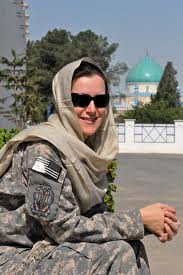
http://navylive.dodlive.mil/index.php/2010/10/19/issues-of-the-veil/#disqus_thread

The U.S. military addresses cultural issues, even in how to dress**

Why does this profound institutional failure persist? I read it and hear versions of the premise that Afghans don’t live in the same globalized world as Americans all the time in defense contexts. The fact that it does persist should give us deep pause about how resources have been expended to create a more ‘culturally aware’ national security community. Continue reading

Posted in: Intercultural Communication, International Politics, Middle East, Narrative and Cognition, Narrative Research, National Security, Political Analysis, Politics and Policy, War and Violent Conflict Tags: , , , , , , , , ,

Lessons in Patriotism

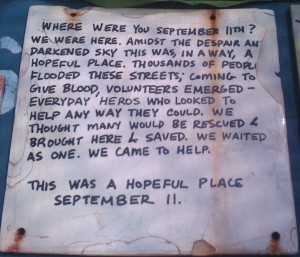
Tile made as part of a project that let people create their own commemorative tiles in 2001; they were later hung on a chain link fence in New York City's Greenwich Village (photo A. Zalman)

Patriotism—love of one’s country—is a treacherous emotion. Too little of it, and we aren’t motivated to make necessary sacrifices on behalf of our national brothers and sisters. Too much of it, or too much of the wrong sort, and exclusionary nationalism—in the form of various ethnic and religious hatreds- takes over. The challenges of getting patriotism right people think that we should avoid these dangers and keep emotion out of our public lives, substituting instead our critical faculties to reason our way to being fair and kind to each other.

But, as philosopher Martha Nussbaum argues, we require this form of love, “distinct from simple approval, or commitment or embrace of principles” in order to act on behalf of people we have never met—those people invoked by the idea of nation. Continue reading

Posted in: Intercultural Communication, National Security, Politics and Policy, War and Violent Conflict Tags: , , , , , , , , , ,

Communal Narrative on Parade at Annual West Indian American Day Carnival

In our social lives, narrative is not only something we tell but also something we perform. Public rituals like parades give us the chance to chronicle our communities in physical space and display the symbols and activities that define us. The words of George Fitch in Colliers Magazine in 1913, testifying to the popular pleasures of parades, are still true today.

The parade is an essential part of the American temperament. We not only inaugurate by parade, but we rejoice, mourn, commemorate, protest, inspire and argue by parades. Whenever two or three Americans are gathered together with a uniform within reach, they parade… The test of true brotherhood in any city is the willingness to parade in a white apron, a rooster feather hat, or a pair of baggy pink silk trousers.

Among the most joyous of these tests today is surely the annual West Indian American Day parade in Crown Heights, Brooklyn, an astonishing celebration of the colors, music and flavors of Carnival in the Caribbean, held this year on September 5, and an exuberant testament to multiculturalism. Continue reading

Posted in: Intercultural Communication, News and Journalism, Popular Culture Tags: , , ,

Narrative in Complex Decision Making: an Interview with Mary Crannell

Mary Crannell is one of those people whose broad intelligence and enthusiasm are hard to contain, as I learned when we met recently through a shared acquaintance. As the president of Idea Sciences, a decision-making support consultancy based in Alexandria, VA, Mary spends much of her time thinking about what technologies and processes will help her customers—such as the IMF, NATO, QinetiQ, the US Army, the UK Army, Verizon and Herman Miller, to name a few—arrive at good decisions. She is a frequent traveler to sites of conflict, as in a recent visit to Kabul, Afghanistan, where decision-making is an urgent, complex and ongoing task.

I was gratified when Mary agreed to share some of her thoughts on the role of narrative in decision-making generally, and in directing the American role in the world in productive directions, which is a concern many of her clients share.

Mary Crannell, President, Idea Sciences

AZ: How do you use narrative frameworks to help people make decisions?

MC: It is important to give people a way to define the vision of what they are trying to accomplish whether they are leading a state, a nation or an international organization. Is the system you are leading “on purpose?” We start with a vision. Continue reading

Posted in: Decision making, Information Systems, Intercultural Communication, International Politics, Middle East, Narrative Research, National Security, Public Diplomacy, Strategic Leadership, War and Violent Conflict Tags: , , , , , , , , , , ,

Egypt Uprising Narrative as Youth, New Media Driven: Wrong

Ala' 'Abd al Fatah (image courtesy of Wikimedia and Manalaa.net under Creative Commons license)

NPR’s Michele Norris interviewed Egyptian blogger and software Ala’ ‘Abd Al Fattah on June 6 about his role and perceptions of the uprising in Egypt that brought down the Mubarak regime earlier this spring. Among Al Fattah’s insights: the narrative of events in Egypt as a primarily youth led and Internet driven and urban are incorrect. As he notes: “by that exclusion you also exclude a very big aspect of what it is about.”

NORRIS: You’re here in this country in part to describe what happened in Egypt. Are there things that happened there that people don’t well understand? Here, when there are large uprisings or large news events like this, a popular narrative takes hold and sometimes it’s correct and sometimes it’s not completely correct.

Mr. AL FATTAH: I think a lot of it is misunderstood and misrepresented in both internationally and even locally from the framing of this as an Internet-led revolution to a framing that it’s a youth revolution. All of that is based on the aspects of reality, but it excludes the majority of the people who participated in the revolution.

And by that exclusion, you also exclude a very big aspect of what it is about. And also, there’s a lot of focus on Tahrir while you had the majority of the revolution was happening outside of Cairo. And some of its most amazing stories were in - there were six towns that were completely autonomous after the third day of the uprising, and people had to manage the cities and had to organize themselves to keep the cities functioning. And that experience is amazing, and it’s not really being discussed.

Two important questions flow from al Fattah’s interesting observations. One is about what is left out of the popular narrative of the uprising as high tech and youth driven. And the second question is why? What is the function of the high tech narrative?

One kind of answer is supplied by Mona el-Ghobashy. Writing in Middle East Report earlier this spring, the Barnard political science professor outlines “the reality … that Egyptians had been practicing collective action for at least a decade” preceding the 2011 events, although their increasing political sophistication was repeatedly characterized as the effect of economic pain Egyptian officials. While social media and mobile phones enabled the synchronization of protests on January 25, it was this ‘invisible’ history that shaped a people capable of such effective demonstrations they toppled a police regime.

As for why the high tech, youth driven narrative holds such sway in Western media: To a degree it reflects a kind of vanity we hold about ourselves. In the United States, in particular, it is hard for us to imagine political sophistication in parts of the world we do not know well, or what it looks like. So we imagine revolutions in the image of ourselves we like best: as an eternally young (vis-a-vis Europe) country whose technologies have enabled and inspired the rest of the world. In one version of the Egyptian uprising, we see a satisfying reflection of the kind of revolution we would have liked to inspire.

Posted in: Intercultural Communication, International Politics, Middle East, Political Analysis, Politics and Policy, War and Violent Conflict Tags: , , , , , ,

U.S. Should Stop Asking if “They Like Us”

The September 11 attacks spawned a public mania in the United States for uncovering whether people in other parts of the world “like us,” and if not, understand why they “hate us.” Ten years later, the U.S. State Department and, more broadly, national security community is still using this uninformative metric.

It is time to break down what the question “do you like the United States” actually means to those who we ask —whether directly through polling, or through the interpretation of symbolic actions (signs, flag burning) or the aggregation of media statements, or in any other fashion.

Most people in the world, especially those of greatest strategic interest to the U.S., cannot answer whether they like the United States based on personal information or knowledge. Despite rising international travel to the United States, most of the 60 million foreign visitors last year came from just five countries: Canada, Mexico, the UK, Japan and Germany.

The number of those who can answer based on a sense of intellectual or cultural proximity is equally small. The common wisdom since World War II is that American popular culture—movies, television shows, McDonald’s—is loved abroad, even when American policies are not. Globalization encourages competition and hybridization of cultural forms. Economics professor Tyler Cowan has argued that the “21st century will bring a broad mélange of influences, with no clear world cultural leader.” Continue reading

Posted in: Intercultural Communication, International Politics, Middle East, National Security, Politics and Policy, Public Diplomacy Tags: , , , , ,

SIETAR Conference on Intercultural Communication Begins Today in Denver

The Eleventh Annual Society for Intercultural Education Training and Research (SIETAR) Conference begins today in Denver. This year’s conference is dedicated to the topic of “Risk and Resilience in an Intercultural World.” In crisis, or other adverse circumstances, reaching across cultural borders can appear to be unduly risky, and it is resilience—the ability to recover from adversity—that must be cultivated if we are to remain engaged with others
SIETAR is a membership organization with satellite groups throughout the United States and abroad. Founded in 1974, the organization was created:

To provide a forum for exchanging ideas about training, theory, and research, and to learn from each other as well as to provide a place where interculturalists could strengthen their bonds with each other. They envisioned an exchange between people in different disciplines and professional activity that would strengthen the theoretical development and practice of intercultural communication.

Keynote speakers include Dr. Todd Conklin, Dr. William Cross and Dr. Pari Namazie. Conklin is a specialist in human error and safety at the Los Alamos National Laboratory in Santa Fe, New Mexico, and the other of an upbeat book on Simple Revolutionary Acts to make ourselves more engaged, happier workers. Cross heads the Social-Personality Psychology subprogram at the City University of New York Graduate Center. Cross is well known for his work on African-American identity, and particularly for his 1991 book Shades of Black: Diversity in African American Identity Namazie works in the field of international human relations management and intercultural management. She is the managing director Atieh International, a strategy, HR and training company focusing on developing business opportunities between the Middle East and Europe.

Posted in: Conferences, Crisis Management, Intercultural Communication Tags: , , , , ,

Egypt Narrative Promises a Long Unfolding

The story of the Egyptian demonstrations continues to unfold (photograph courtesy of Rami Raoof under Creative Commons license)

The story of the Egyptian demonstrations continues to unfold (photograph courtesy of Rami Raoof under Creative Commons license)

The current events unfolding in Cairo offer little in the way of narrative comfort. Instead, news commentators, analysts, even participants—weighing in breathlessly from the street on Twitter or Al Jazeera—seem struck by ambiguous meaning of events. Is looting spontaneous or sponsored by the Mubarak government to provoke requests for government protection? There are no clear successors to a Mubarak government, and no clear mechanism for a non-military succession. Why have the police abandoned the protests?

Continue reading

Posted in: Intercultural Communication, International Politics, Middle East, National Security, Political Analysis, War and Violent Conflict Tags: , , ,