category archive: Books & Films

Book Review: Communities of the Future Could Flourish amid Technological Change. Here’s How.

Media headlines devote an increasing amount of attention to how governments and large corporations can plan for the future. We know change is coming: in climate, in demography, in the availability of natural resources, in the structure of economies.

Yet little attention—until now— has been given those who must live the effects of those changes: the community leaders and their constituents who battle floods and heat, deal with aging neighbors and their needs, find ways to educate children who were born digital, and not least match the newly jobless to new work, in a shifting economy that is likely to be further disrupted by automation in coming years.

Rick Smyre and Neil Richardson propose a new vision for the future of local communities

Rick Smyre and Neil Richardson propose a new vision for the future of local communities

In their new book, Preparing for a World that Doesn’t Exist—Yet: Framing a Second Enlightenment for Communities of the Future, Rick Smyre and Neil Richardson address that lacuna. They fill it with worthy insights for community leaders who want to think and plan now for a world being overturned by technology and its effects. The authors are persuasive in their reminder that since communities are where change is implemented and felt, it is in communities where a transformation in leadership and planning must take place. As they point out, reforms do not actually change systems, only transformations do.

A New World Requires a New Language

The book is not an easy read. It is overflowing with neologisms: Master Capacity builder, the Creative Molecular Economy, and Polycentric Democracy are just a few of many terms the authors use to describe their new concepts. But stick with them, and a method behind this lexical riot begins to come clear.

If we are in fact at the edge of a wholly new world, visible to us only through the weakest of signals on the horizon, we will need a new language to describe it. Smyre and Richardson call this a‘different kind of different’ understanding. The authors describe this new world through a set of discrete principles that repeatedly stress how we will shortly live in environments that are interconnected, interdependent and in which non-linear effects unfold.

What this means is that we need a new community strategic narrative: a way of talking about and living in communities in a way that we are not used to. Everyday life in a thriving future community may feel at its best like a constantly unfolding set of connections, opportunities and solutions. This is a far cry from a daily routine that, if it is routine, satisfies us with its orderliness and lack of surprise. We will all need to learn anew how to live in this kind of future. What Smyre and Richardson propose is that we can learn, and that our community leaders can help us to do so.

An Exhilarating Vision, A New Story for Local Communities

Preparing for a World that Doesn’t Exist Yet is ultimately exhilarating — it swings from provocative abstractions to concrete recommendations and ideas, including worksheets, to address communities’ educational, governance, economic and healthcare needs in the emergent future.

Take, for example,the future economic framework they envision.

The “Creative Molecular Economy,” as distinct from the industrial and knowledge economies before it, will be characterized by a constant state of disruption (thus it is ‘creative’) and by individual entrepreneurs who will co-create “products, service and ideas” through “interlocking networks” (thus, molecular).

After working through this idea, the authors turn to the concrete ways that communities can plan for and leverage this state of affairs. Does a community need, for example, concept papers to begin thinking about how to get more start-up capital for entrepreneurs in the door? Could a Futures Economy Council in the local chamber of commerce seed a network of future-minded citizens? What about pilot programs and events that begin to introduce citizens to this new economic structure? Yes, yes and yes, of course.

In these narrative swerves, Smyre and Richardson have created a book seems to resemble the future they envision: It overflows with connections and interconnections, big ideas and micro-plans, leaps and deep observations. The book isn’t linear, so you don’t have to read it in order to appreciate the authors’ vision of future communities that embrace technological change, while helping all of their citizens realize their best potential.

You can buy the book on Amazon here.

**Disclaimer. I know the authors and am mentioned in the book’s preface.
Posted in: Books & Films, Decision making, Innovation, Politics and Policy, Strategic Leadership Tags: , , , , , , , , , ,

7 Necessary Narratives for the New Digital Age

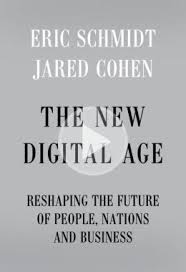
In the future, nearly everyone will be connected to the Internet and to each other, claim Jared Cohen and Eric Schmidt in The New Digital Age.

Mass connectivity will transform our relationships, our governments, our work, our bodies and the objects around us. But even these dramatic transformations will not change the fact that we are corporeal creatures, and that we will still live lives grounded in phnew digital agephysical circumstances, whether those are urban or rural, rich or poor, lucky or unlucky.

We will also come into the world with a set of inherited stories about who we are, what our lives mean, and what the future looks like. These stories will have the same universal threads they always have: we will still have stories of love, stories of family, stories that try reconcile life’s fundamental unfairness. But they will also fail in important ways to explain the transformations of our lives, and the new ways in which we will do old things.

We need new stories

We need new stories. Creating them is of necessity not only a collective task, but a transnational one. As we grow even more connected, we also grow more capable of exporting our ideas about who we are and what is important on others, wherever they are. Yesterday, two Nigeria-descended men hacked a third to death on a London street, and then stayed on the scene to tell how they saw themselves in a world at war: “We must fight them as they fight us.” As we grow more connected, and more willing to share our selves with others, maybe pernicious forms of shame—that universal emotion—will be knocked out, and we’ll be more healthy.

It all depends on how we decide to tell our future. Here are seven of the areas where we will need new stories in the new digital age, as described by Schmidt and Cohen.


7 Necessary Narratives for the New Digital Age

1. The Body

Both religion and science fiction have long dreamed of worlds in which humans transcend bodies, to become virtual souls. In the new digital world, however, we will shape our identities online but experience them in the physical world. How will we understand health and illness, and mortality, if we have the capacity to monitor our daily rhythms in minute ways?

2. Personal Identity

Schmidt and Cohen tell us that identity will be each of our most valuable commodity in the future, and that our true personal identity will be the one that we shape online.

How will we choose to tell our life stories and in what ways will the autobiographical form change in a world in which there is essentially no privacy? Where will we think our “real” self resides. Where will the associations with privacy as a space of intimacy, daydreaming, erasable exploration, unrecorded experimentation with who we are, in order to practice who we could be, relocate, when we have no privacy?

3. News

Our concepts of journalism and news reporting have already undergone dramatic changes; journalism has become in many ways a collective task that falls to professional reporters and citizens alike, and to groups and organizations that put out versions of the news that support particular causes or points of view.

As an increasing number of voices join in the journalistic task, the work of professional media will evolve. The media might become a trusted validator of unsubstantiated accounts, or an integrator of news from different kinds of sources. The value of objectivity may fade, while versions of what subjective news that maintains its integrity will emerge—this will be the new narrative of news.

4. Cybersecurity

Different forms of public security – whether they are in the arena of health, or counterterrorism, or child safety – operate according to different metaphors, storylines and images. Those around cyber-security may coalesce around metaphors of health and hygiene: we are told to practice “cyber-hygiene.

Schmidt and Cohen introduce Microsoft Chief Research and Strategy Officer, who has also recommended a “World Health Organization” for cyber-activity, and the practice of quarantining computers that have been infected with viruses. As Adriane Lapointe, a National Security Agency official has observed, the public health metaphor may serve as the basis for a meaningful public narrative:

Like any good metaphor, it invites us to consider illuminating similarities between two overtly dissimilar things—malware on the internet and infectious disease in a community—similarities that can lead us to reframe a familiar topic. It also identifies a policy precedent, reminding us that we do, as a society, recognize the need to impose some restrictions on individuals who involuntarily pose a certain kind of threat to others, and that we have a mechanism to do this which might be relevant to cybersecurity matters. Whether we ultimately decide that this mechanism or approach is appropriate to the cyber challenge, the metaphor has certainly helped to broaden thinking about the subject.

5. National Identity

The nation-state has been the bedrock of our civic identities for the last couple of centuries, and the idea that every nation deserves its own territorial state a driving narrative of the 20th century. But new diasporas resulting from increased migration, coupled with digital connectivity, are decoupling the nation from the state, creating virtual, de-territorialized nations.

How will a de-territorialized nation narrate its future? How will cultural practices that have been grounded in place be translated into practices of other place? Will other forms of bonding, such as investment in the home country, become a standard part of an individual’s narrative of their national identity? Will the idea of a relationship to a particular land wither for some communities, and if so, to what effect?

6. Dissident Leadership

There is much to protest in this world, and the low cost of entry to share dissident views will lead to a widening number of protestors seeking attention for their cause. Many of these causes will be worthy and compelling, so it is no longer enough to offer the platitude the most persuasive stories will gain our attention. Rather, we—the public that dissidents must win over-may begin to change the meta-story, or standards, by which we evaluate leaders and causes.

Schmidt and Cohen offer that dissident leaders likely to become popular will be able to: “command a following and crowd-source their online support,” will know how to exploit digital marketing tools, and will show their commitment by putting themselves at physical risk.

We can already guess that digital marketing skills are not the most important skills for someone seeking a leadership role in a dissident setting. We can use this recognition starting now to inoculate ourselves against easily accepting simply the most digitally skilled. We can ask, instead, what are the qualities—what is the story—of a leader who is likely to be successful, who understands the institutions they want to change, and lead that change on the ground as well as in virtual space.

7. Justice

Cameras in our smallest devices make it easy to record the human capacity for barbarism in its many forms. Violence, sexual assault, cruelty to animals, hate speech all find their way into digital form on a regular basis, easily arousing our instinctual repugnance. As Schmidt and Cohen observe, these recordings can become the basis for “crowd sourced justice,” which may take the form of mob retaliation, from harassment to violence.

But we could instead form new habits of collective responsibility—using our connectivity to make sure that those who commit bad acts are dealt with according to our legal precepts and best values, and to explore together how to deal with bad behavior at the community level. Which narrative, and which set of practices that prevail, depend on how we decide to narrate our opportunity to ‘crowd source justice,’ which behaviors we highlight and celebrate, and how we talk about what we see online.

Posted in: Books & Films, Intercultural Communication, International Politics, Marketing & Branding, Popular Culture, Public Relations Tags: , , , , , , ,

Let’s Celebrate the 2nd Anniversary of “A National Strategic Narrative”

This has been a tough spring for national cohesion in the United States. Automatic federal spending cuts called sequestration kicked in after Congress failed to agree on how to manage the federal budget. The Senate voted down a bill that would expand background checks for gun purchasers, despite strong support around the country. And bombings at the Boston Marathon committed by young men hovering between foreign identity and American citizenship confused any clear idea of American identity.

This makes it a good time to mark the two year anniversary of A National Strategic Narrative, published in April 2011 by aNational Strategic Narrativeuthors Captain Wayne Porter, USN and Col Mark Mykleby, USMC under the pseudonym Mr. Y.

The document grabbed the attention of politicians and pundits here in the United States, and foreign ministers in Europe and the Middle East. Perhaps most important, it garnered attention from everyday citizens for proposing a reinvigorated American identity and role in the world. Continue reading

Posted in: Books & Films, Decision making, Intercultural Communication, International Politics, National Security, Politics and Policy, Strategic Communication, Strategic Leadership Tags: , , , , , , , , , , ,

Narrative for Survival: My Grandmother’s Story

Stories can save lives. In One Thousand and One Nights, Sheherezade uses her storytelling talents to end King Shahrayr’s plot to punish his unfaithful wife by punishing all of the women of his kingdom. Having put to death the unfaithful Queen herself, the King embarks on a plan to marry a virgin of the Kingdom each night, and to have each killed at dawn. That is, until he marries Sheherezade, who spends her wedding night narrating to the King a most exciting and suspenseful tale. So exciting that the King puts off her death to hear how the story continues. And so their story continues for a thousand and one nights, after which the King abandons his goal to punish women, and marries Sheherezade.

My grandmother may not have had a thousand stories, but she had at least one, and telling it to an American Consul in 1939 saved her life and that of her husband and baby, when it permitted her to leave warring Europe on one of the last ships to cross the Atlantic. I had the opportunity to tell it at a local TedX event earlier this year, and was delighted when TEDx organizers chose it as one of their favorites. I’d love to hear about other stories that have saved lives, if you have one you’d like to share.

Posted in: Books & Films, Intercultural Communication, International Politics, Narrative forms, Politics and Policy, Popular Culture, War and Violent Conflict Tags: , , , , , , , , , ,

Intertextuality for Strategic Communication

The Power of Reference, Allusion and Quotation in Communication

Two recent films, Skyfall and Anna Karenina, are made more intensely meaningful by their intentional intertextuality-their incorporation of previous iterations and interpretations of the story they are themselves telling. Both offer insights into the ways communicators can benefit from the same kind of internal referentiality.

The Concept of Intertextuality

Literary and linguistic theorists began to work with the concept of intertextuality in the mid-1960s, when theorist Julia Kristeva coined the term. Scholarly definitions have proliferated and grown increasingly technical in the intervening half century. For our purposes, the following definition works just fine: Intertextuality means that texts – novels, paintings, films, but also tax codes and thank you letters –gain meaning not through their reference to an external reality, but by their reference to pre-existing other texts. Intertextuality is not a choice, but rather an inevitable by- product of creating, because we are always creating into already existing histories, discourses and ways of interpreting. These existing frames have already partly shaped what we will produce and how it will be recieved. An author or an artist may intend to give us something original, but they can’t, fully. We readers, in turn, never have direct access to a work, but can only get at it by making our way through its prior iterations and interpretations.

James Bond and Anna Karenina are among the most iconic popular texts in modern Western culture. The James Bond series, which is the longest-running film series in history, has given us the rules by which we define spy thrillers. Anna Karenina is no longer only the Leo Tolstoy novel, but also the dozens of derivative films, ballets, operas and musicals that have been created since the late 19th century.

Both are completely enmeshed in our everyday language — we think things about ourselves through the mesh of their expressions:“Bond, James Bond,” and “Shaken, not stirred,”are shorthand invocations of suave masculinity. “All happy families are alike, but each unhappy family is unhappy in its own way,” has become a catch-all syntax for describing the singularity of just about anything, including in statistics, where the “Anna Karenina principle” is applied to ecological and economic puzzles.

Semiotics professor Daniel Chandler explains the implications of intertextuality: Continue reading

Posted in: Books & Films, Intercultural Communication, Marketing & Branding, Narrative forms, Popular Culture, Public Relations, Strategic Communication Tags: , , , , , , ,

Behavioral Economics Go to War

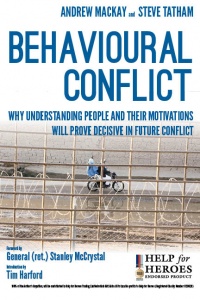
Review of Behavioural Conflict, Why Understanding People and their Motivations Will Prove Decisive in Future Conflict, by Andrew Mackey and Steve Tatham

I cannot think of any books about warfare’s future that come across as hard-hitting, full of actionable pragmatism, and deeply humane all at the same time. But Behavioral Conflict: Why Understanding People and their Motivations will Prove Decisive in Future Conflict is all three. The authors, both career members of the British military, Major General Andres Mackey (Ret) and Royal Navy Commander Steve Tatham (who I count as a friend, having met him in Ankara a few years ago), make their case by drawing on a combination of their own experience, case studies and close analysis of how communication actually factors in war.

Hard-hitting and pragmatic: Mackey and Tatham are precise and lucid about what they mean by “behavior” and how to make use of it to gain advantage in conflict. They, and behavioral psychologist Lee Rowland, who adds a chapter on the science of influence, are not putting forth any of the following: A call for greater “cultural awareness,” a mushy program about how to change others’ attitudes, or a repeat of the last decade’s focus on consumer marketing as the key to public diplomacy. They offer instead this thesis based on a simple chain of claims:

  • The world of human motivation and perception is inevitably complex.
  • It is more important to try to shape behavior than it is to change people’s attitudes.
  • Behavior shaping begins with a discrete grasp of the circumstances under which people already behave in ways that are desirable, and extends to efforts to replicate those or similar circumstances. Continue reading

Posted in: Books & Films, Decision making, Intercultural Communication, International Politics, Narrative Research, National Security, Politics and Policy, Strategic Leadership, War and Violent Conflict Tags: , , , , , , , , , , , , , , ,

Review: “The End of the West: the Once and Future Europe”

English political theorist and former Labor Party MP David Marquand’s recently published The End of the West: the Once and Future Europe, comes at an opportune moment. The Greek financial crisis, U.S. jibes at NATO, and the suggestion by disgruntled British conservative party members that the UK quit the EU foretells a continental reckoning at hand.

Marquand’s thesis is that changing global circumstances press into relief both unresolved ambiguities that now must be resolved if the European Union is to continue as a viable institution. The creators of the European Community were eager to forge the organization, and to feel they were beginning to put the outrages of hyper-nationalism, in Nazism and fascism, and the ethnic hatreds exemplified by the Holocaust behind them. These terrible events stood in sharp contrast to the modern Western self-ideal: rational, egalitarian, and humanist, rather than racially minded, and the European Community was a way to return Europe to that better model of itself.

As a result of this fervor to move beyond the horrors of World War II, the founders of the European Community (later the European Union) never explored ambiguities regarding the implications of being “European.” These included complex issues of ethnic identity vis-à-vis national and European identity, the degree to which supranational governance would override the national sovereignty of member countries, and basic questions about geography—what are the territorial boundaries of Europe, and are they identical with some sort of defining quality of Europeanness? Continue reading

Posted in: Books & Films, International Politics, Middle East, Political Analysis, Politics and Policy, War and Violent Conflict Tags: , , , , , ,

5 Points about Using Numbers in Narrative

random-colored-numbers-480x309

1. Numbers and Narratives: Frenemies

We want to sort story from statistic. Story can seem to be spin, while numbers appear to speak for themselves and reflect an unimpeachable reality. Our insistence that what is “social be “science” makes us think that numbers can stand in for reasoning and context to explain the world around us. Yet, we also don’t understand statistics very well, which makes most of us easy victims of numbers that only seem to mean something, when they’re cushily framed by persuasive stories. But it wasn’t always so, recounts Roberto Franzosi in From Words to Numbers. Consider:

…the etymological roots of the words “count” (numbers) and “recount,” as in narrative or tell a story (words). The word “recount” was imported into English from the French reconter in the fifteenth centry. In French, the verb reconter, a close proxy of conter, hasd been adopted in the twelfth century from the Latin computare (meaning reckon and calculate). And computare (meaning reckon and calculate). And numbers, telling and measuring, counting and recounting, were once simply intellectual activities, involved thinking, or, more appropriately, enumerating or going through a sequential list.

Here then, a short list of ways to bridge the historical divide, and reunite narrative and number.

2. Frameworks Institute: “Don’t fight the narrative with numbers”

According to Frameworks, which helps institutions shape discourse around social issues, numbers and facts are not persuasive to people, if the cited numbers counter strongly held worldviews.

The fact is that many Americans find it hard to digest data and interpret it; mathematical literacy is a major hurdle. But, that aside, the psyche is often resistant to data that erode a comfortable view of the world. Quite often, the numbers are reinterpreted to substantiate an entirely different conclusion. From the social science roots of framing research we learn this maxim: If the facts don’t fit the frame, the facts get rejected not the frame.

New numbers won’t fix an outworn frame, is the message. Continue reading

Posted in: Books & Films, Narrative and Cognition, Narrative Research, Politics and Policy Tags: , , ,

The Psychology of Conspiracy Theorists

Conspiracy Theories are Narratives on Steroids

President Obama's Birth Certificate Doesn't Quell Conspiracy Theory that He Isn't an American Citizen

Conspiracy theories are narratives on steroids. In a story, the plot moves forward when one thing causes the next. In a conspiracy theory, cause is an outsized malignant force that knows everything and controls all events. Nothing happens randomly, all events are tied to the larger purpose of an always mysterious, always malefic agent. The amplification of current events into objects of global scrutiny also amplifies conspiracy theories, making them powerful agents in shifting public opinion. Thus with the so-called Birthers framing of President Obama as a foreigner, despite the overt presentation of facts proving that the president was born in the American state, Hawaii.

Conspiracy theorists stubbornly resist the facts at hand, finding reasons other than those given for why events unfold the way they do. Many Pakistanis appear to doubt that Osama bin Laden died as reported in mainstream news. According to a Gallup poll, “nearly half (49%) thought that the whole incident was actually staged for some reason or other. Only 26% thought the al-Qaeda chief was really killed on the night in question.” That’s a lot of people who think that the story circulated in mainstream media is crackpot, at best. And this week, 57% of respondents to a French poll believe that Dominique Strauss-Kahn is the victim of a conspiratorial plot by political rivals, rather than the victimizer of a hotel housemaid, as has been reported. Continue reading

Posted in: Books & Films, Conspiracy Theories, International Politics, Narrative Research, Politics and Policy, Popular Culture Tags: , , , , , , , ,

How to Market an Unpopular Cause

Kosovo Albanian ethnic costume/dance, courtesy of WikimediaKosovo Albanian ethnic costume/dance, courtesy of Wikimedia

How do you market an unpopular cause?

In a world crowded with attention-worthy causes, why do some get the backing of the international community, while others languish? This good question is being asked by the recipients of this year’s Hope Fellowship, a fund established by the National Albanian American Council to strengthen the role of women in policy and decision-making in the Balkans. They are seeking recognition for their largely unrecognized country, Kosovo, which split off from Serbia and declared independence in 2008. In order to help them in an upcoming training session, I went looking for new models that might help structure the challenge of making their so-far-unpopular country more widely understood in the European Union and beyond.

There are no easy models or quick fixes for a people seeking to establish a legitimate identity among other nations, as Kurds and Palestinians well know. And an over focus on media and message dissemination (should we have a Facebook page? How many radio stations?) while important, is no replacement for the deeper work of developing a national identity story that resonates in international channels.

While seeking models, I found two excellent books that shed light on how embattled causes get attention from the international community. Although they are both specific to politics, they offer valuable insights for any organization seeking to make an impact on another.The Marketing of Rebellion: Insurgents, Media and International Activisim by
Clifford Bob has been highly regarded since its publication in 2005.

Bob seeks to answer the question: “How do a few political movements challenging Third World states become global causes célèbres, whereas most remain isolated and obscure? He answers answers by looking through the dual lens of marketing and globalization. The marketing perspective, as he puts it, “denies that there is a meritocracy of suffering,” in which NGO backing and international sympathy lie—as we would hope—with the best causes. Instead, “local movements insistently court overseas backing, and their promotional strategies count.” Continue reading

Posted in: Books & Films, International Politics, Marketing & Branding, Public Diplomacy Tags: , , , , , , ,