
Angela Glover Blackwell understands the power of stories to shape—and even change— outcomes. The founder and CEO of research and action institute, Policy Link, Blackwell’s goal is economic and social equity in the United States.
In order to explain why that’s important, she tells a dual story. One is about making sure that future Americans-the majority of whom will be people of color-are positioned  equitably to get the best education and jobs their talents permit.
The second is about the future of American competitiveness in the world: “If this country wants to have a middle class and be competitive in the global economy, we need to make sure that the people who are going to be the future are ready for the future,” Blackwell said in a recent interview with NPR Marketplace’s Morning Report.
There is genius in this narrative entwining personal and national economic advancement.
First, it displaces negative stories about the need for racial equality. Many efforts to tell this story end up slamming unproductively against barriers of racism and fear. Listeners are afraid that advocating for equality is some kind of code for inequality through favoritism, or advocacy of a “big government,” or “welfare.”
Second, Blackwell’s story replaces negative and fearful stories about people of color and poverty with a positive one that makes every American a stakeholder in an equitable future for all. A rising tide lifts all boats; economic fairness for all. The story transforms a potentially hostile audience—those who may feel that individual effort is being pitted against a big government giving handouts—into beneficiaries and even heroes of a fair system. Blackwell tells the story in data as well: “If we had eliminated racial inequities in 2011, the GDP would have been $1.2 trillion higher.”
The story about the future that Policy Link tells has constructed has all the right traits for gaining critical mass. Like all good strategic narratives, it can put a check mark next to all of these criteria:
- Heroic, participatory roles for a range of stakeholders. It makes poverty and inequality, not people, the story’s villain.
- Engages collective values, such as Americans’ belief in fairness and the story of the United States as a leading player on the world stage.
- Open ended It tells us the problem—no equity—but doesn’t dictate to us how to get to a happier ending, leaving us free to imagine our own next steps.
Map Stories to Find New Stakeholders, New Routes to Desired Outcomes
Organizations that fail to construct strong stories to guide communication and strategy can find themselves in trouble. Take Blackberry, the formerly dominant smartphone maker now struggling to come back from a 45% drop in sales in the last year.
One way to stress test a strategy is to “storify” it. Take it apart, map it, find out where it began, where it is going, what assumptions underwrite current directions, and where it could go in the future.
Deputy business editor at the New York Times David Gillen described Blackberry’s failure to adjust to a changing landscape “commitment escalation.” Companies “focus on their product rather than listening to their market changing.” Other analysts have suggested Blackberry didn’t focus enough on what existing customers liked, such as the QWERTY keyboard.
Mapping strategy as a story, in which each step leads to the next for a reason, can lay bare gaps in the strategy, suggest alternatives, or point to the need for more research. A firm turning solipsistic and forgetting to engage its most important stakeholders—its customers—as it proceeds could discover the oversight by retelling its strategy as a story. It might, along the way, discover that it is important to situation the customer, not the product, as the hero.
Narrative network mapping can help identify stakeholders, and strengthen strategy
Mapping strategy as a story begins with articulating its beginning-the current challenge-and its end: Where do you hope to end up? (Mapping, of course, might change that endpoint). At every point in between, there will be people and actions driving the strategic “plot.” Asking who has a stake in each step can help uncover stakeholders that may not have been apparent in the beginning, whether competitors or naysayer or beneficiaries. Communicating with and acknowledging their needs strengthens and enlarges the story you hope to tell, linking it to other stories. Public narratives are intrinsically networked, so the more paths your story travels. the stronger it is.
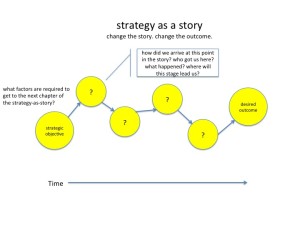
Relate and review strategy as a story to find gaps, hidden assumptions, alternative routes
Working through strategy as a story can help you:
- Find stakeholders in unexpected places who may serve as advocates for your cause
- Develop alternative outcomes and options that may not be evident at first
- Create a strong basis for overall strategy: Knowing the story will help guide how your organization communicates, with whom, and guide the steps to cultivating advocates.